


Most kitchen organization advice starts and ends with the same suggestions: drawer dividers, cabinet door bins, pull-out shelf inserts. And if your problem is a messy junk drawer, those are fine. But if your real problem is that you've run out of cabinet space entirely — the counters are crowded, the pantry is overflowing, and you're stacking things on top of other things — drawer inserts won't help you at all. You need more storage, not better sorting of the storage you already have.
That's where open vertical racking earns its place in the conversation. And yet it rarely gets one.
Why the Default Advice Doesn't Work for Small Kitchens
The "organize your kitchen" content that dominates Pinterest and home blogs is largely written for kitchens with plenty of cabinets. The assumption is that you have space — you just need to use it more cleverly. Drawer organizers, lazy Susans, and cabinet risers are all legitimate tools for that problem.
But in a small apartment kitchen, a galley rental, or an older home where the cabinets were built for a different era of cooking, you're not dealing with wasted space. You're dealing with genuinely not enough space. Adding a drawer insert into a cabinet that's already packed doesn't create room — it just rearranges the chaos.
The fix isn't to organize inside the cabinets harder. It's to move some of what's inside the cabinets out onto vertical storage that lives in the open.
Open vs. Enclosed: What You Actually Get for Your Money
Cabinet organizers — pull-out drawers, door-mounted bins, shelf risers — tend to solve one problem: visibility inside a cabinet. They're useful, but they're also locked to a single location, and they only help with what's already inside that cabinet. They don't add net storage to your kitchen.
Open tiered racks and rolling carts do something different. They add storage surface area to your kitchen without requiring a single cabinet, a drill, or a landlord's permission. They're freestanding, they move, and because the shelves are open, everything on them is visible at a glance — no digging, no rearranging, no forgetting what's in the back.
The cost comparison is also worth thinking about honestly. A set of decent cabinet organizers — door bins, a pull-out shelf, a drawer divider set — can add up quickly, and you still haven't gained any new storage. A mid-range rolling cart gives you three full shelves of usable space, often for a comparable or lower total spend, and it can move to wherever you need it most.
What Actually Lives Well on an Open Rack
Not everything belongs on an open rack, and being honest about that matters. Anything that needs to stay sealed, anything that looks genuinely messy, or anything you rarely use is probably better off in a cabinet. But a surprising amount of what people reach for daily is perfectly suited to open shelving:
- Oils, vinegars, and sauces — the bottles you grab every time you cook don't need to be hidden
- Dry pantry staples in jars — lentils, grains, pasta, spices in clear containers look intentional on a rack
- A coffee or tea station — the kettle, the beans, the mugs, the filters, all in one movable spot
- Cleaning supplies under the sink overflow — dish soap refills, extra sponges, cloths
- Produce that doesn't need refrigeration — onions, garlic, potatoes, citrus
The key is grouping by use, not by category. A rack that holds your morning coffee setup on the top shelf, your most-used cooking oils in the middle, and dish towels and cleaning cloths on the bottom is doing real organizational work — not just storing things.
The Rolling Cart Advantage in a Small Kitchen
A fixed tiered shelf is useful. A rolling cart is useful and flexible, which is a meaningful distinction in a small kitchen where the layout has to work for cooking, cleaning, and sometimes eating all in the same tight space.
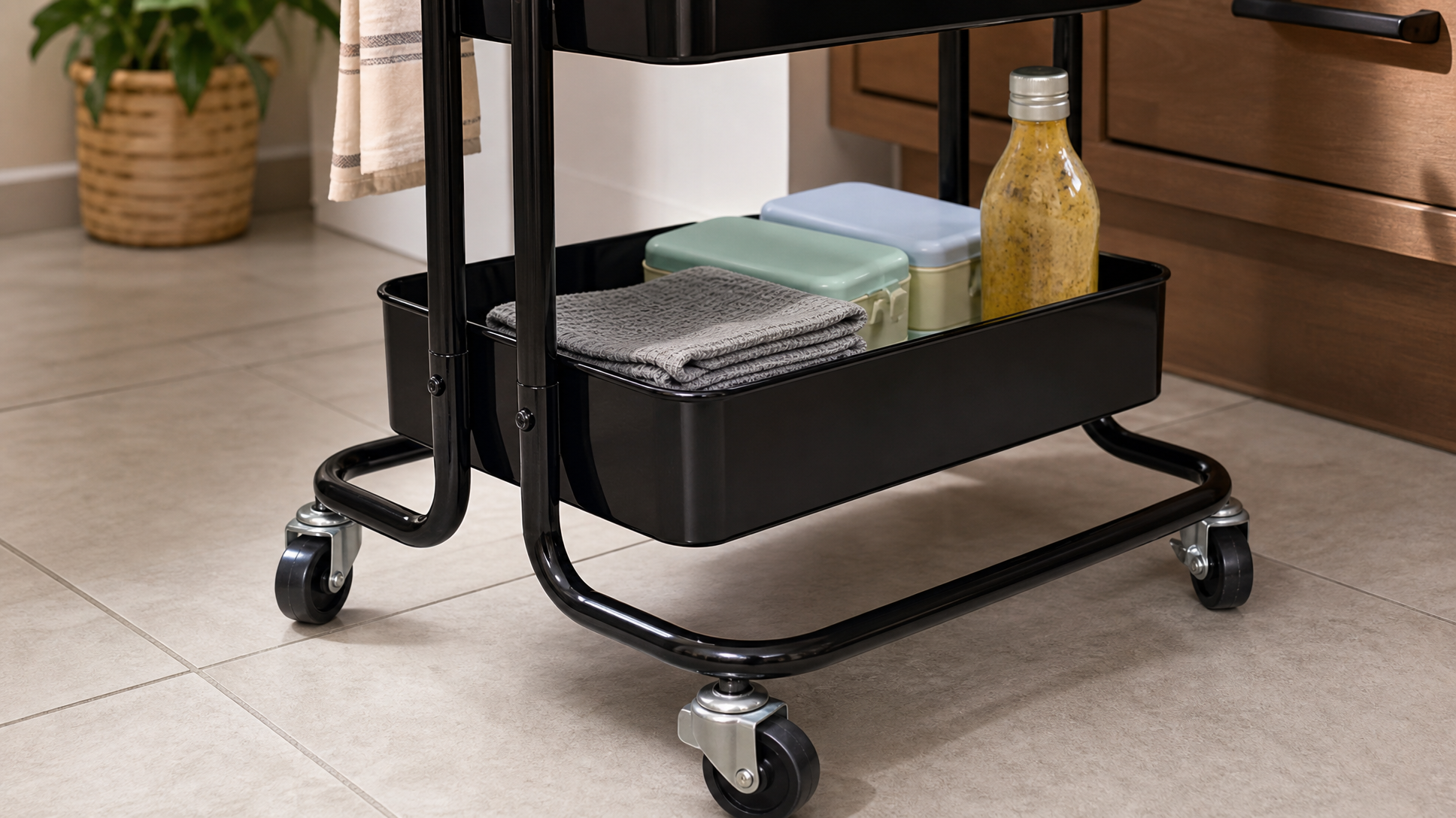
USTECH's 3-Tier Rolling Cart is built around exactly this kind of flexibility. The black powder-coated metal frame is slim enough to tuck into the gap beside a refrigerator or at the end of a counter run. The three open basket-style shelves give you genuine vertical storage — not just a flat surface with a lip. When you need to mop, rearrange, or pull it closer to the stove while you cook, the swivel caster wheels make that a two-second job. When you need it to stay put, the lockable wheels hold it in place. It's the kind of thing that sounds like a small detail until you've actually used a cart without locking wheels and watched it drift across the floor every time you grab something off it.
The durable metal construction also matters more than it might seem for kitchen use. Carts that live near a stove or sink deal with humidity, grease, and the occasional spill. A powder-coated steel frame handles that far better than plastic-framed alternatives that warp or crack over time.
For anyone living in a rented apartment or a home where drilling into walls isn't an option, a rolling cart is also one of the few storage solutions that requires no installation whatsoever — assembly is straightforward, and when you move, it comes with you.
A Few Things to Get Right When You Set One Up
Where you place the cart matters more than people expect. Near the stove works well for oils and spices you reach for constantly. Near the sink makes sense for dish supplies and towels. Beside the coffee maker is an obvious win for a dedicated coffee station. The mistake is parking it wherever there's floor space and then loading it with whatever doesn't fit elsewhere — that's how it becomes a second junk pile instead of an actual system.
Keep the top shelf for the things you use most. It's the easiest to reach and the first thing you see. The bottom shelf is for bulkier, heavier items — extra bottles, cleaning supplies — that you access less often. Middle shelf is the everyday workhorse. That simple top-to-bottom logic makes the cart genuinely useful rather than just a place to put things.
And if you're wondering how this fits into a broader approach to home organization, this deeper look at clutter-free home strategies covers how vertical and mobile storage systems work together across different rooms — not just the kitchen.
The Bottom Line
If your kitchen is short on cabinet space, spending money on cabinet organizers is solving the wrong problem. Open vertical racking — especially a rolling cart with lockable wheels and durable shelves — adds real, usable storage where you actually need it, keeps everyday items visible and reachable, and costs less than a full cabinet overhaul. It's not a compromise. For a lot of small kitchens, it's the better answer.
Browse USTECH's rolling carts and tiered metal racks — built for kitchens where cabinet space runs short.
Frequently Asked Questions
Will a rolling cart look out of place in a kitchen?
Not if you load it intentionally. A black metal cart holding neatly arranged jars, bottles, and a few kitchen staples reads as purposeful, not cluttered. The key is grouping items by use and keeping the shelves from becoming a catch-all. Matching containers or decanting dry goods into clear jars helps too.
Can a rolling cart hold heavy items like large bottles or cast iron?
A powder-coated steel cart is generally sturdy enough for pantry staples, bottles, and kitchen supplies. That said, you should always check the specific weight capacity listed for any cart you're considering before loading it with very heavy items. Cast iron cookware is better stored elsewhere — on a pot rack or in a lower cabinet — where the weight is properly supported.
Is open shelving in the kitchen harder to keep clean?
It requires a different kind of maintenance than closed cabinets. Dust and cooking grease can settle on open shelves over time, so a quick wipe-down every week or two keeps things looking good. The upside is that nothing gets forgotten — if something's dusty, you'll see it immediately, which tends to keep the shelves tidier overall.
Can I use a rolling cart in a rental without losing my security deposit?
Yes — that's actually one of the biggest advantages of a freestanding rolling cart over built-in shelving or wall-mounted organizers. There's no drilling, no wall anchors, and no installation required. It sits on the floor on its own wheels, and when you move out, it comes with you.


