


Most shoe racks described as 'adjustable' mean one thing: the shelves wobble a little and you can nudge them into a slightly different position before they settle back where they started. That's not adjustable — that's just loose.
The USTECH 3-Tier Adjustable Shoe Rack works differently, and the difference is specific enough to be worth explaining before you buy. If you're already considering this rack and want to know what you're actually getting, this is the breakdown.
What the Slide-n-Adjust System Actually Does
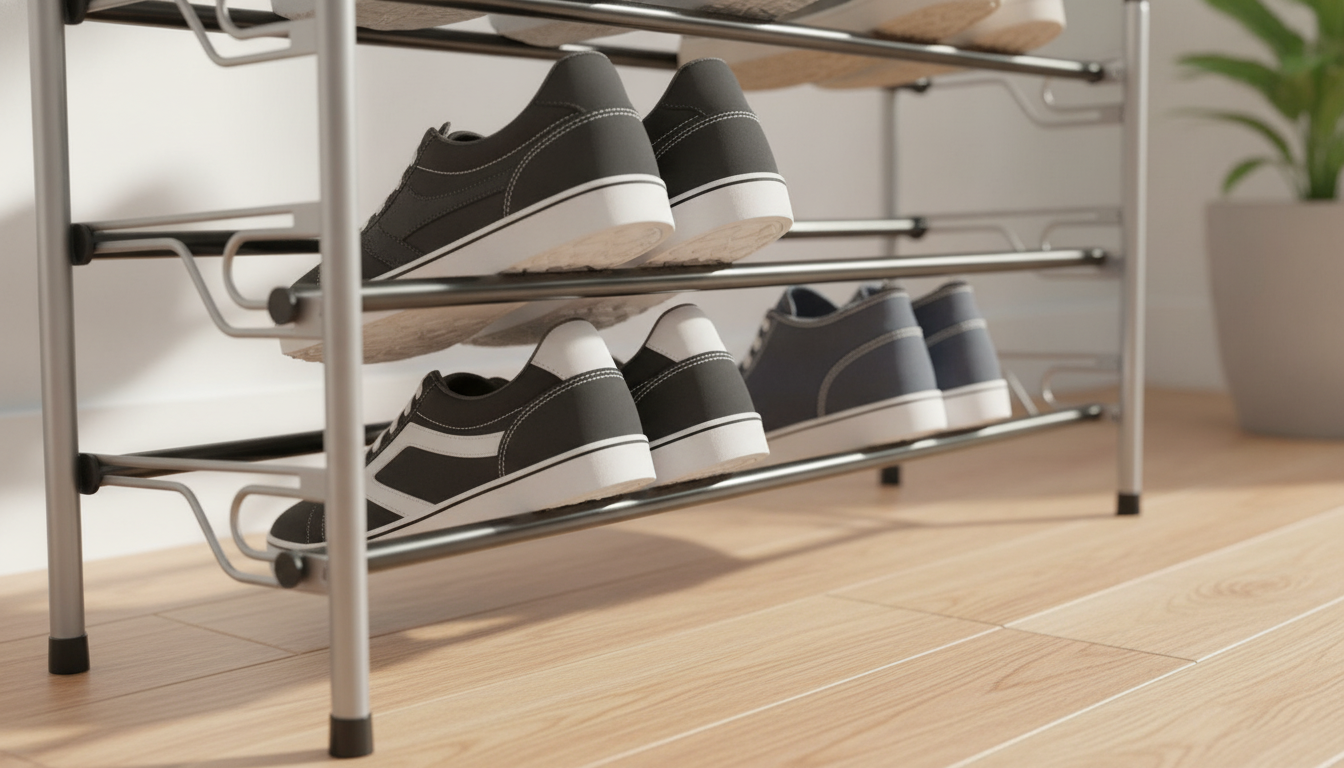
The patented Slide-n-Adjust system gives you two distinct shelf positions — flat and angled — and lets you choose independently for each tier. That matters more than it sounds.
Flat position works best for boots, bulkier sneakers, or anything with a sole thick enough that angling it would waste vertical space. Lay them flat and stack them neatly side by side.
Angled position is where the rack earns its keep for everyday shoes. Tipping the shelf forward lets you fit more pairs per tier by staggering heel-to-toe depth — the heel of one pair tucks under the toe of the pair above it. It's the same principle professional shoe stores use, and it genuinely gets more shoes into less vertical space.
The ability to mix and match positions across tiers is what separates this from a standard rack. Your bottom tier might hold flat-positioned boots while the top two run angled for your daily sneakers. You're not locked into one configuration for the whole unit.
Horizontal Expansion: Fitting the Rack to Your Space, Not the Other Way Around
The rack expands horizontally — up to 45 inches wide — by sliding the frame outward along the rails. This is useful in two situations that come up constantly in real homes.
First, you have an entryway or closet with an awkward width. Most fixed-width racks either leave dead space on the sides or don't fit at all. Expanding this one to match your available width means you're using the full footprint of the space.
Second, your shoe collection isn't static. A rack that starts at a narrower setting can grow with you — add more pairs, expand the width, keep everything visible and accessible instead of piled up.
The silver vertical poles and black horizontal rails visible in the photo give you a clear sense of how the expansion works: the rails slide through the frame, and the rubber feet keep the whole structure stable on the floor once you've set the width you want.
Stacking: Going Vertical When Floor Space Runs Out
The 3-tier rack is stackable — you can add additional US Tech shoe rack units on top to build vertically. If you're working with a closet that has more ceiling height than floor space, this is the move.
It's also useful for separating shoe types by household member. Stack one unit for one person's shoes, another for a partner's or a kid's, and you've got a system that stays organized without anyone's pairs bleeding into someone else's section.
The alloy steel frame handles the weight of stacking without flexing, which is the detail that makes vertical expansion practical rather than just technically possible.
Where This Rack Actually Fits
The use cases that suit it best:
- Entryways — the horizontal expansion means it can span a wider wall section, keeping shoes out of the walking path
- Closets — the angled shelf position maximizes pairs per tier in tight vertical spaces
- Bedrooms — freestanding and portable, so it moves if your layout changes
- Dorms — compact enough to fit under a lofted bed, expandable as needed
- Hallways — the slim profile and rubber feet mean it sits flush against a wall without sliding
The non-slip chrome surface on the rails keeps shoes from sliding off the angled shelves — a detail that's easy to overlook until you've had a pair of sneakers fall off a cheaper rack at 2 a.m.
Assembly: What to Expect
The DIY in the name is accurate but not intimidating. The frame uses a tool-free push-and-click assembly — the poles slot into connectors at the corners, the rails slide into place, and the rubber feet cap the legs. Buyers consistently note that it goes together quickly and without frustration, which tracks with the straightforward design: there are no small screws to lose, no Allen key required.
Set your shelf positions after assembly, expand the width to your space, and you're done. If you move or rearrange, the whole thing breaks down and reassembles just as easily.
If you want more on the broader case for getting a shoe rack in the first place — why it's one of the highest-impact, lowest-effort organization moves you can make — this guide covers it well.
The Bottom Line
A shoe rack that only comes in one width and one shelf angle is a shoe rack that fits some homes and frustrates everyone else. The Slide-n-Adjust system — flat or angled shelves, expandable width, stackable design — means this one adapts to your space instead of forcing you to adapt around it. That's the actual difference, and it's worth understanding before you set it up.
Ready to build your own setup? Shop the 3-Tier Adjustable Shoe Rack at ustech-usa.com.
Frequently Asked Questions
Can I use the angled shelf position for all shoe types, or just sneakers?
The angled position works well for most low-to-mid-profile shoes — sneakers, flats, loafers, and similar styles. For taller boots or shoes with a very thick sole, the flat position usually makes more sense since it gives each pair full clearance without tipping awkwardly. The Slide-n-Adjust system lets you set each tier independently, so you're not forced to pick one mode for the whole rack.
How wide does the rack expand, and does it stay stable at full width?
The rack expands horizontally up to 45 inches. The alloy steel frame and rubber feet are designed to keep the structure stable across the full expansion range — the rubber feet grip the floor and prevent sliding regardless of where you set the width.
Do I need tools to assemble this shoe rack?
No tools are required. The frame is designed for tool-free assembly — the poles and rails connect without screws or hardware. Most buyers report it goes together quickly, and the same process works in reverse when you need to break it down or move it.
Can this rack be used outdoors, like on a covered porch or in a garage?
The alloy steel construction is built to hold up in various conditions, making it a reasonable option for a covered entryway, garage, or mudroom. For prolonged direct exposure to rain or moisture, any metal rack benefits from being kept under cover — but for typical indoor-adjacent spaces, the durable frame should hold up well.


