


The Drawer Trap That Stops Most People Before They Start
You decide today is the day. You pull open a dresser drawer, and thirty seconds later you're holding a shirt from 2016, trying to remember if you actually like it. An hour passes. The drawer looks worse than when you started. You close it and walk away.
This isn't a willpower problem. It's a sequencing problem. Drawers are the worst possible starting point for a first-time declutterer — not because they're unimportant, but because folded-clothes decisions are slow, emotional, and invisible. You can spend two hours on a single dresser and have nothing to show for it except a pile on the bed and a vague sense of defeat.
The better move? Start with what's already out in the open. The shoes by the front door. The jacket draped over the chair. The three bags sitting on the closet floor. These items are faster to process, give you an immediate visual reward, and free up the floor space you need to keep going.
Why Visible Clutter Is the Right First Target
When you're new to decluttering, momentum is everything. The goal of your first session isn't to make a perfect decision about every item you own — it's to finish something. Visible, floor-level clutter gives you that.
Shoes are a perfect example. You can sort a pile of twelve shoes in ten minutes. You either wear them or you don't. There's almost no sentimental weight attached to a worn-out sneaker, and the decision is binary: keep or go. Compare that to a drawer of old t-shirts, where every item has a memory attached and nothing is clearly wrong with any of it.
The other advantage is spatial. Clearing the floor gives you room to work. Once you can actually move around your bedroom or entryway without stepping over things, the rest of the process feels less claustrophobic and more manageable. That open floor isn't just aesthetic — it's functional breathing room.
A Practical Sequence That Actually Works
Here's the order that tends to work well for beginners, starting with the easiest decisions and building toward harder ones:
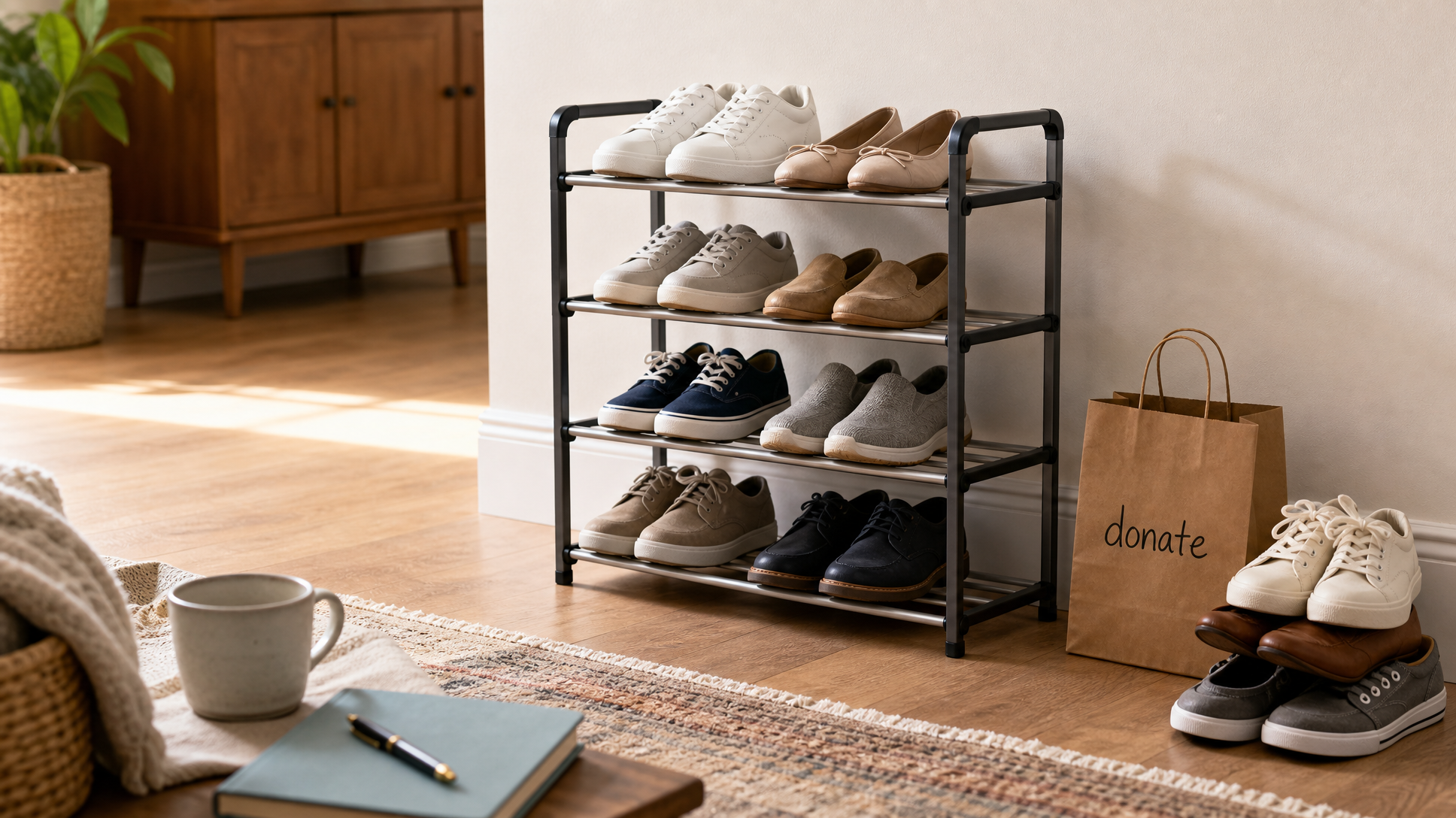
- Shoes on the floor. Gather every pair from the entryway, bedroom floor, closet floor, and under the bed. Sort them into three groups: wear regularly, wear occasionally, haven't touched in over a year. The third group is your first donation or trash bag. What's left gets a home — ideally on a rack rather than back on the floor.
- Clothes draped over furniture. The chair, the door hook, the treadmill. These items are already in a limbo state — you didn't put them away, which usually means they're either dirty or you're not sure where they belong. Sort them into laundry, hang up now, or doesn't belong in this room. This takes fifteen minutes and completely changes how a room looks.
- Bags, totes, and luggage. These tend to pile up in corners and on closet floors. Empty each one, decide if it's staying, and give it a dedicated spot. A luggage rack in a guest room or closet corner handles this better than stacking bags on top of each other.
- The closet rod (before the drawers). Now you're ready to look at hanging clothes. This is still faster than drawers because you can see everything at once. Go item by item: does it fit, do you wear it, does it have a problem that needs fixing? Items that pass stay. Everything else goes in a bag immediately — don't set it aside "to think about."
- Drawers last. By the time you get here, you've already made dozens of decisions and you're in a rhythm. Drawers are harder, but you're warmed up. Work one drawer at a time. Finish one before opening the next.
The One Thing That Makes the Difference Between Done and Almost Done
The reason decluttering sessions often don't stick isn't that people keep too much stuff — it's that the stuff they keep has nowhere to go. You sort the shoes, decide on twelve pairs, and then put them back on the floor because there's no rack. You hang up the clothes from the chair, but the closet rod is so crammed that everything slides to the middle. Within a week, it's back to where it started.
This is where two simple pieces of hardware matter more than any organizational method: a shoe rack and a set of proper hangers. A shoe rack gives floor-level items a defined home so they don't drift back to the door. Hangers that actually hold their shape — and don't bunch up or slip — mean clothes stay where you put them instead of ending up on the chair again.
Neither of these needs to be complicated. A multi-tier shoe rack that fits in an entryway closet or along a wall handles most households. Hangers with non-slip coatings and a pant bar keep your closet rod organized without any extra effort on your part. USTECH makes both, built specifically for this kind of everyday use.
What to Do When You Hit a Decision You Can't Make
You will hit one. Everyone does. The trick is not to let one hard item stop the whole session.
If you genuinely can't decide about something, put it in a box, label it with today's date, and set it somewhere out of the way. If you haven't opened the box in a few months, donate it without looking inside. This isn't a trick — it's a practical way to separate the emotional weight of a decision from the physical work of clearing a space.
Don't let the hard items slow down the easy ones. Keep moving. The goal of a first session is to finish the floor and the visible surfaces. Drawers and the hard stuff can wait for session two.
One Last Thing Before You Start
Get your donation bags and trash bags ready before you begin — not halfway through. The moment you have to go find a bag, you lose momentum. Set up three: donate, trash, and relocate (for things that belong in a different room). Having the containers ready means decisions stay decisions instead of becoming a search for supplies.
For more on building a genuinely clutter-free home beyond the first session, this guide on the ultimate tools for a clutter-free home is worth reading once you've got the floor clear.
Ready to start? USTECH's shoe racks and multi-tier hangers are the two pieces of hardware most beginners are missing — find them at ustech-usa.com.
Frequently Asked Questions
How long should a first decluttering session actually take?
Plan for two to three hours for a single room if you're starting with floor-level and visible clutter. That's enough time to sort shoes, clear draped clothes, and work through the closet rod without burning out. Drawers can be a separate session on a different day — trying to do everything in one go is how people end up exhausted and quit.
What if I don't have much floor space to work with?
Start in the hallway or entryway instead of the bedroom — it's usually the smallest area with the highest concentration of floor clutter (shoes, bags, coats). Clearing it takes less than an hour and gives you a finished space to look at while you tackle larger rooms. That visual win matters more than it sounds.
How do I stop the clutter from coming back after I've sorted everything?
The short answer: every item needs a specific home, not just a general area. Shoes drift back to the floor when there's no rack. Clothes end up on the chair when the closet rod is too crowded to make hanging easy. Fixing the storage — a proper shoe rack, hangers that actually work, a luggage rack for bags — is what makes the difference between a one-time tidy and a room that stays organized.
Is it worth buying storage products before I declutter, or after?
After — always. Buy storage once you know exactly how many shoes you're keeping and how much closet space you're working with. Buying bins and racks before you sort often means you end up organizing clutter rather than eliminating it, and you'll likely buy the wrong size anyway. Sort first, measure what's left, then shop.


