


The Real Problem Isn't That You Own Too Much
Most wardrobe advice starts with "get rid of things." But if you're the kind of person who keeps the blazer you wore once in 2019 because it might come back around — and honestly, it might — a minimalism lecture isn't going to help you. What you actually need is a smarter system for the stuff you're keeping.
The difference between a chaotic closet and a functional one usually isn't the number of items. It's whether each item is stored the right way. Hanging things that should be folded wastes rod space. Folding things that should be hanging turns them into a wrinkled pile you'll never touch. And ignoring racks entirely means your shoes and luggage are eating square footage your clothes could use.
Here's the category-by-category breakdown — no purging required.
What to Hang (Almost Always)
The rod is prime real estate. Use it for items that wrinkle badly when folded, lose their shape in a stack, or need to be visible to actually get worn.
Blazers, Jackets, and Structured Tops
These need a hanger. Full stop. Folding a structured blazer collapses the shoulder — and once that crease sets, no amount of steaming fully fixes it. Use a hanger with shoulder notches so the garment stays put instead of sliding off every time you brush past it.
Dress Shirts and Button-Downs
Folded dress shirts go from "ready to wear" to "needs ironing" faster than almost any other garment. Hang them, button the top button so the collar holds its shape, and give them enough space that the sleeves aren't crushed against the next shirt over. A non-slip coating on your hangers makes a real difference here — shirts stay centered instead of creeping toward the floor.
Dresses and Jumpsuits
Anything with a defined waist, a long skirt, or delicate fabric belongs on a hanger. Folding a maxi dress is a commitment to ironing it before every wear. Hanging it takes two seconds and keeps it ready.
Trousers and Dress Pants
Folded trousers develop a horizontal crease across the thigh that's hard to remove. Hanging them by the waistband — or better, over a pant bar — keeps the crease exactly where it should be: down the front of the leg. A hanger with a pant bar built in handles this without any extra hardware.
What to Fold (More Than You Think)
Folding gets a bad reputation because most people do it in a way that creates chaos — stacking shirts horizontally in a drawer until the bottom half becomes an archaeological dig. Done right, folding is actually more space-efficient than hanging for a surprisingly large category of clothes.
T-Shirts, Casual Tops, and Sweatshirts
These don't wrinkle in a way that matters, and they don't need to hold a shape. Hanging them wastes rod space that your blazers and dress shirts actually need. Fold them vertically (file-style in a drawer) so you can see every shirt at a glance without disturbing the ones below it.
Jeans and Casual Pants
Denim is heavy, and a full rod of hanging jeans is a rod that's running out of space fast. Fold them and stack them — or file them vertically in a deep drawer. The one exception: if you have a hanger with a pant bar and the rod space to spare, hanging one or two pairs you reach for daily is perfectly fine.
Knitwear and Sweaters
This is the one where hanging actively damages the garment. A heavy knit sweater on a hanger will stretch at the shoulders within a few weeks, leaving two little bumps that never go away. Fold sweaters and store them on a shelf or in a drawer. If you're stacking them, keep the stack to three or four deep so you can actually get to the one you want.
Underwear, Socks, and Loungewear
Drawer items, always. No hanger strategy applies here. The goal is just a consistent folding method so the drawer doesn't become a tangle every time you reach in.
What Belongs on a Rack
Racks — shoe racks and luggage racks specifically — solve a category of storage problem that neither hangers nor folding can touch. They get things off the floor and out of corners without requiring a dedicated room or a major renovation.
Shoes
Shoes piled on a closet floor are a space disaster. A single pile of eight pairs takes up roughly the same footprint as a five-tier shoe rack that holds significantly more — and actually lets you see what you own. A tiered rack with adjustable shelves is especially useful if your collection mixes flats, sneakers, and heeled boots, since the shelf spacing can shift to fit whatever you're storing.
The other benefit: shoes stored on a rack stay paired and visible. The ones buried at the bottom of a pile tend to stop getting worn simply because you forget they exist.
Luggage
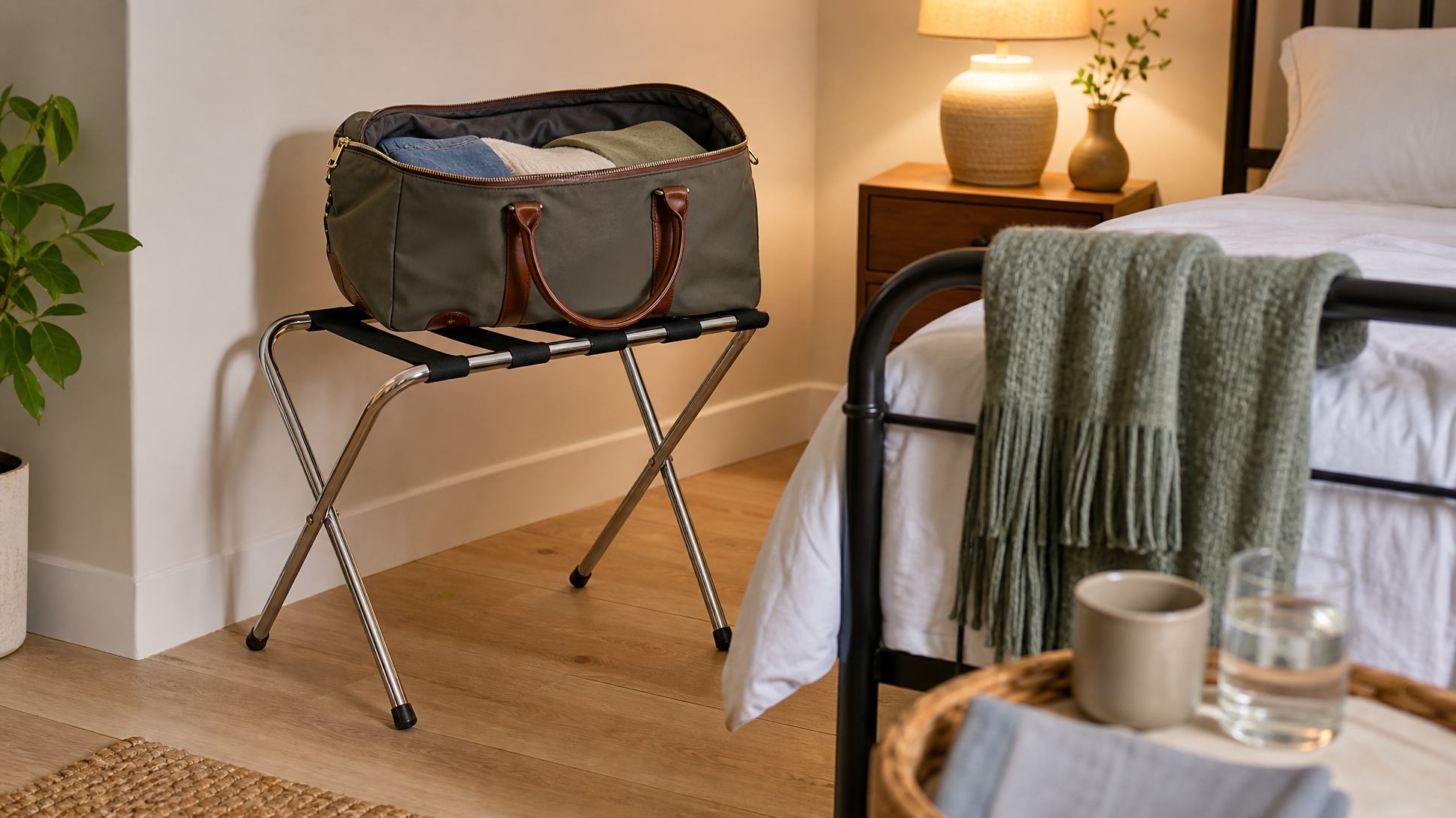
Suitcases and duffel bags are awkward to store because they're large, oddly shaped, and used infrequently enough that they end up shoved wherever they fit — usually a corner, under a bed, or stacked precariously on a shelf. A dedicated luggage rack keeps a bag off the floor, accessible, and ready to use without a ten-minute excavation. In a guest room, a folding rack also doubles as a surface for guests to unpack onto, which keeps the rest of the room tidy during a visit.
A Quick Reference: Fold, Hang, or Rack?
| Item | Best Storage Method | Why |
|---|---|---|
| Blazers & structured jackets | Hang | Preserves shoulder shape |
| Dress shirts & button-downs | Hang | Prevents wrinkles, stays ready to wear |
| Dresses & jumpsuits | Hang | Avoids creasing long or delicate fabric |
| Trousers & dress pants | Hang (pant bar) | Keeps crease in the right place |
| T-shirts & casual tops | Fold | Saves rod space, wrinkles don't matter |
| Jeans & casual pants | Fold | Heavy on the rod, fine folded |
| Sweaters & knitwear | Fold | Hanging stretches the shoulders |
| Shoes | Rack | Gets pairs visible and off the floor |
| Luggage & bags | Rack | Keeps awkward shapes accessible and tidy |
The Hanger Itself Actually Matters
One thing chronic keepers run into fast: once you start hanging the right things, you realize your rod is more crowded than it looks — because bulky plastic hangers eat up an inch or more per garment. Switching to slimmer hangers with the right features (shoulder notches to stop slipping, a pant bar for trousers, a non-slip coating for silky or lightweight fabrics) lets you fit noticeably more on the same rod without the pile-up.
It's a small swap that adds up quickly when you're working with a standard closet and a full wardrobe. For more on how the right hanger changes what a closet can hold, this guide covers the details.
Start With One Category, Not the Whole Closet
The reason most reorganization attempts fail isn't lack of motivation — it's scope. Pulling everything out at once and trying to sort it in an afternoon is a recipe for putting most of it back exactly where it was, just slightly more neatly.
Pick one category from the table above and fix just that. Move your sweaters off the rod and onto a shelf. Get a shoe rack for the pile by the door. Switch your dress shirts to better hangers. Each small fix makes the next one easier, and within a few weeks you have a system that actually holds — without having gotten rid of a single thing you wanted to keep.
Ready to make the rod work harder? See USTECH's space-saving hanger and rack options — built for closets that need to hold more, not less.
Frequently Asked Questions
Can I hang sweaters if I don't have drawer space?
You can, but you'll want to fold them over the hanger bar rather than hanging them by the shoulders — looping the sweater over a pant bar keeps the weight distributed and avoids the shoulder-stretch problem. It's not ideal for very heavy knits, but it's a reasonable workaround when shelf or drawer space is genuinely limited.
How many pairs of shoes can a typical tiered shoe rack hold?
It depends on the rack's tier count and the size of the shoes, so check the specific product's listed capacity before buying. A multi-tier rack with adjustable shelves gives you the most flexibility, since you can space the shelves wider for boots or tighter for flats depending on what you own.
What's the best way to store shoes I only wear occasionally?
Keep them on the rack but toward the back or a less-accessible tier. The goal is that they're still visible and paired — so you actually remember you own them — without taking up prime front-of-rack space that your everyday shoes need. If you're storing seasonal shoes, a clear box on a shelf above the rack is another solid option.
Does the type of hanger really make a difference for a crowded rod?
Yes, more than most people expect. Standard bulky plastic hangers can be an inch or more wide each — multiply that across a full rod and you lose significant hanging space. Slimmer hangers with features like shoulder notches and non-slip coatings let you fit more garments in the same linear space while keeping each piece secure and properly shaped.


