


Every decluttering guide eventually gets to the closet. Sort by category, donate what you haven't worn in a year, fold the sweaters. Good advice. But there's a step nearly everyone skips — and it's the reason a freshly edited closet gets chaotic again within a few weeks.
The hangers themselves.
If you're simplifying your wardrobe — whether you're downsizing to a smaller home, clearing out decades of accumulated clothing, or just trying to make a single closet do the work of two — the hardware you hang things on matters more than most people realize. The wrong hangers turn a well-edited wardrobe into a tangled, overcrowded rail. The right ones make a compact closet genuinely easy to navigate every single morning.
Why Hangers Are a Decluttering Problem
Think about what a typical closet rod holds: a mix of wire hangers from the dry cleaner, plastic ones in three different sizes, a few wooden ones, and maybe some velvet ones that seemed like a good idea at the time. Each type holds one thing. A shirt hanger holds a shirt. A skirt hanger holds a skirt. A pants hanger holds pants.
So a complete outfit — say, a blouse, a blazer, and a pair of trousers — might take up three or four separate hangers. Multiply that across a wardrobe of even modest size and you're looking at a rod that's completely packed before you've even started on the seasonal items.
When you're downsizing or simplifying, the goal isn't just fewer clothes. It's fewer decisions and less physical effort to manage what you keep. A closet where you have to push through a wall of hangers to find one pair of trousers isn't organized — it's just slightly less full than it used to be.
The Case for Combination Hangers
A combination hanger — one that handles both tops and bottoms on the same frame — directly cuts the number of hangers you need. Instead of a shirt on one hanger and its matching pants on another, both hang together. That's not a small thing when you're working with a closet that's already tight on space.
The USTECH wood-look combination hangers are built around exactly this idea. Each one has contoured, notched shoulders for shirts, blouses, and suits, plus a chrome metal bar at the bottom fitted with two adjustable alligator-style pinch clips. The clips hold skirts or pants securely — and because they're adjustable, they work on different garment weights and widths without leaving marks or creases.
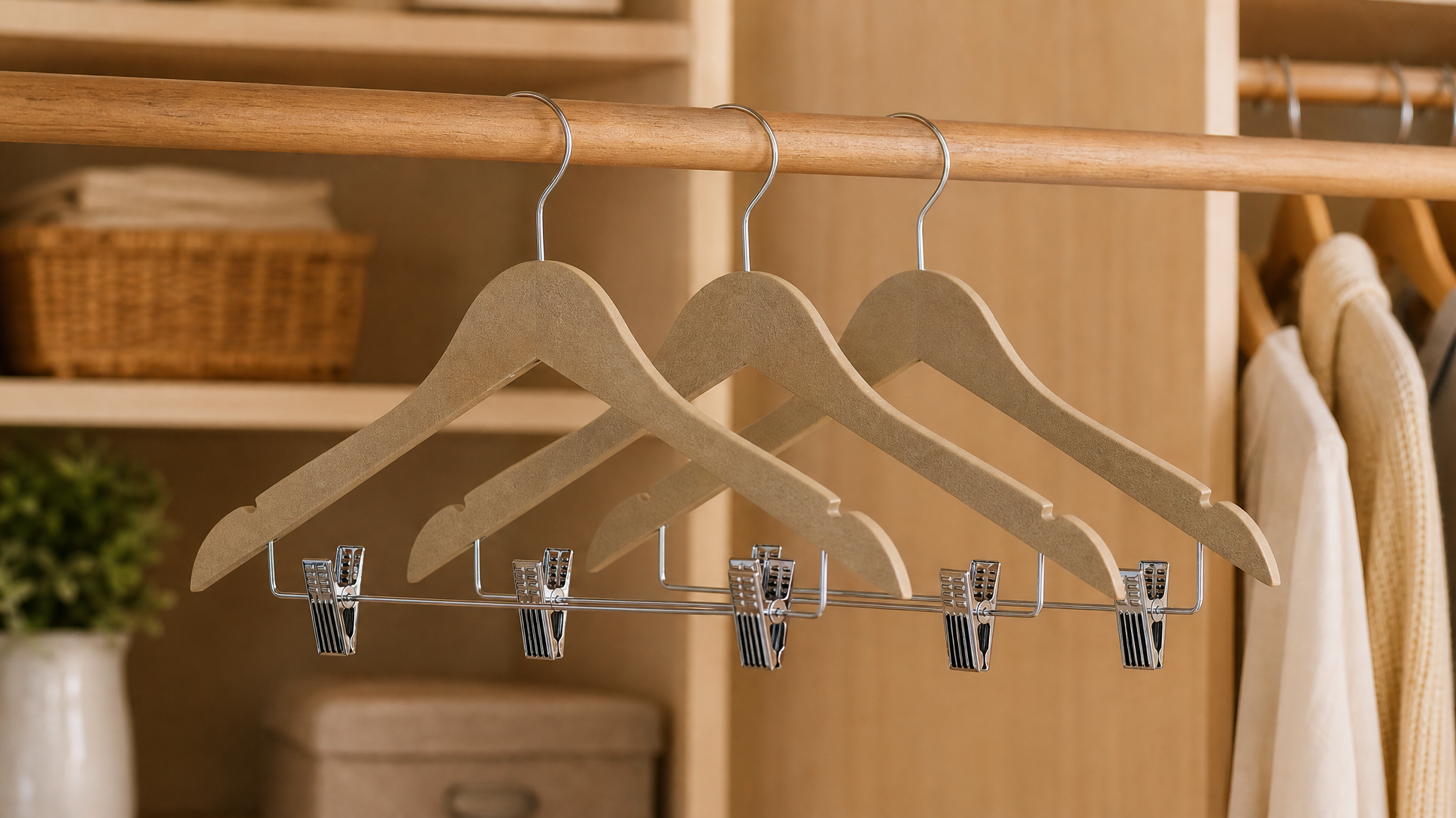
The 360-degree swivel hook is a detail worth noting for anyone who finds a packed closet physically frustrating to use. You can pull a hanger out from any angle without having to wrestle the rod — which matters when you're reaching into a smaller, tighter space.
The slim, flat profile means these hangers sit closer together on the rod than bulkier alternatives. You're not just reducing the count; you're reclaiming actual physical space on the rail.
How to Actually Do This (Before You Touch a Drawer)
The sequence matters. Most people declutter first and then think about organization afterward. That's backwards — or at least, it misses an opportunity. Here's a more effective order:
- Pull everything off the rod first. Don't sort by category yet. Just clear the rail completely and set the clothes aside. This gives you a clean look at how many hangers you actually own and what condition they're in.
- Discard the unusable hangers immediately. Wire hangers from the dry cleaner, broken clips, mismatched plastic ones — those go. They're not doing you any favors and they take up space on the rod.
- Decide how many hangers you actually need. Count your hanging garments realistically. With combination hangers, a suit jacket and its trousers share one hanger. A blouse and a skirt share one hanger. You may need significantly fewer than you think.
- Hang outfits together, not categories separately. Instead of grouping all shirts, then all pants, try hanging complete or likely outfits on a single combination hanger. This makes getting dressed faster and reduces the daily effort of matching pieces across a crowded rod.
- Now edit the clothes. With the rod set up properly, it's easier to see what you actually have — and what's taking up space without earning it.
This order works because the hanger switch gives you an honest picture of your closet's real capacity. You might find you have room for more than you thought, or that you can finally see every garment clearly for the first time in years.
What Makes This Particularly Useful When Downsizing
Downsizing — whether you're moving to a smaller home, transitioning to assisted living, or simply trying to reduce what you manage day-to-day — often means going from a large walk-in closet to a single reach-in. The math changes completely. Every inch of rod space becomes valuable.
Combination hangers address this directly. They reduce the total hanger count, keep matching pieces together so nothing gets lost at the back of the rod, and the notched shoulders mean strappy tops and dresses don't slide off and end up on the floor. For anyone who finds bending down to pick up fallen clothes difficult, that last point is more than a convenience — it's a real quality-of-life improvement.
The durable wood-look construction also means these hangers hold their shape and grip over time. You're not replacing them every year. For a wardrobe you've already taken the time to carefully edit, that durability matters.
For more on building a genuinely clutter-free home from the ground up, this guide covers the broader picture — worth reading alongside this one if you're tackling the whole house, not just the closet.
A Simpler Closet Starts at the Rod
The clothes get most of the attention in any decluttering project. But the system you hang them on determines whether the closet stays organized or drifts back to chaos. Fix the hangers first, and the rest of the process gets easier — because you can actually see what you're working with.
Simplify your closet with USTECH combination hangers — shop the set at ustech-usa.com.
Frequently Asked Questions
How many hangers do I actually need after switching to combination hangers?
It depends on how many hanging garments you keep, but the number typically drops noticeably. If you currently hang tops and bottoms separately, you can expect to need roughly half as many hangers for those paired items — since each combination hanger handles both a top and a bottom together. Count your hanging pieces and work from there rather than guessing.
Will the clips damage delicate fabrics like silk or lightweight trousers?
The adjustable alligator-style pinch clips on these hangers are designed to grip without leaving permanent marks, and because they're adjustable, you can position them at the waistband seam or hem rather than on the fabric face. For very delicate items, folding a small piece of tissue or fabric between the clip and the garment is a common and effective precaution.
What's the best way to organize a small closet after switching hanger types?
Hang complete or likely outfits together on a single combination hanger rather than grouping all shirts in one section and all pants in another. This makes daily dressing much faster and keeps the rod from looking like a jumbled mass of separate pieces. Work from most-worn to least-worn left to right, so the things you reach for every day are always within easy reach.
Are these hangers suitable for heavier garments like wool coats or thick trousers?
The contoured, solid wood-look construction is built to support the weight of everyday garments including trousers and structured jackets. Very heavy outerwear like thick winter coats generally does better on a dedicated coat hook or a heavier specialty hanger — but for the bulk of a typical wardrobe, these are well-suited to the job.


