

Here's the thing about kitchen organization content: it almost always ends the same way. You click on a "budget hacks" article, and by the third paragraph you're looking at a full set of labeled acrylic jars, a drawer full of bamboo dividers, and a pegboard that requires drilling into tile. None of it is cheap, and none of it actually creates more space — it just makes the clutter look prettier.
The real problem in most kitchens isn't a lack of containers. It's a lack of usable vertical space. Deep cabinets where things get buried. Countertops that shrink the moment you set anything on them. Pantry shelves spaced too far apart to stack anything efficiently. Fix those problems first, and you'll need far fewer bins than you think.
Stop Organizing Horizontally — Go Vertical Instead
The average kitchen cabinet is deep enough to swallow things whole. You push the olive oil to the back, and three weeks later you're buying a second bottle because you couldn't see the first one. The fix isn't a lazy Susan (though those help). It's a slim tiered rack slid inside the cabinet to create two or three visible levels where there was only one flat surface before.
A tiered rack inside a deep cabinet lets you see everything at a glance — canned goods on one level, oils and vinegars on another, spice jars up front. Nothing gets buried. Nothing gets duplicated. The same logic applies to pantry shelves that are spaced too generously for what you're actually storing: a small riser or a two-tier shelf insert turns one underused shelf into two functional ones.
This is the core of rack-first kitchen organization: you're not adding more storage, you're making the storage you already have actually work.
The Rolling Cart Trick Most People Miss
A rolling cart is one of those things that looks like a convenience purchase but is actually a genuine space strategy — if you use it right.
The mistake is treating it as a permanent fixture. You roll it into a corner, load it up, and it becomes a stationary shelf that's slightly harder to dust. That's not the move. The smarter approach is to treat it as flexible, movable storage that earns its floor space by doing more than one job.
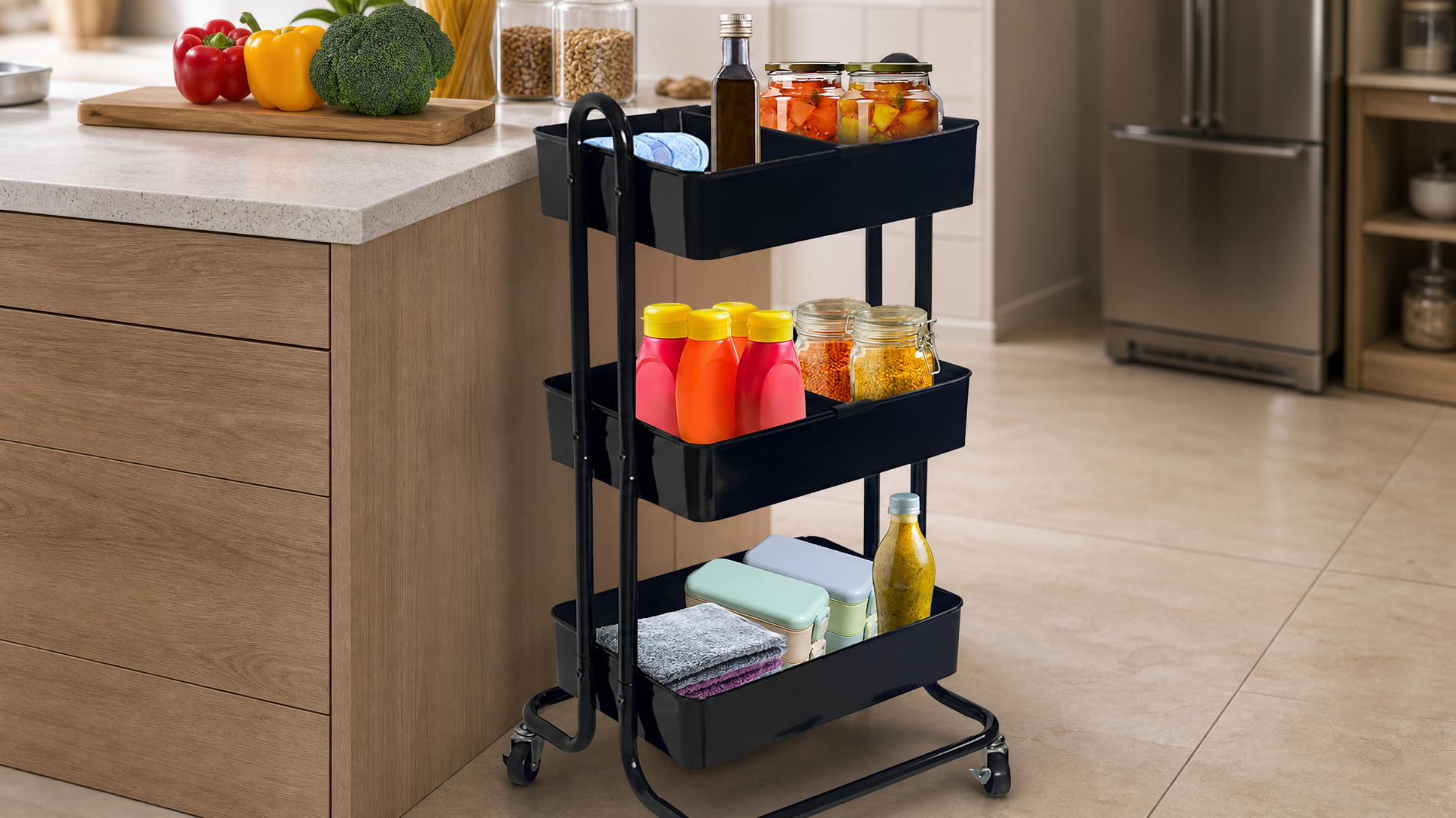
In a small kitchen, a 3-tier rolling cart can live tucked beside the fridge or in a narrow gap between the counter and the wall. When you're cooking, roll it next to your prep area and load it with the oils, sauces, and spices you actually reach for. When you're done, it rolls back. On weekends when counter space matters, it moves into the pantry or a hallway. The cart doesn't have to live in one spot — that's the whole point of the wheels.
USTECH's 3-tier rolling cart is built around exactly this kind of flexibility. The black powder-coated metal frame is slim enough to slide into gaps that would otherwise go to waste, the four swivel casters make it genuinely easy to reposition, and the lockable wheels mean it stays put when you need it to. Three open shelves give you enough room to separate categories — produce on the bottom, pantry staples in the middle, frequently used bottles and jars on top — without turning it into a junk collector.
It's also one of those pieces that transitions well between rooms. Start it in the kitchen. If your needs shift, it moves to the bathroom for towels and toiletries, or to a home office for supplies. Mid-range in price, and genuinely multi-purpose — that's a better value than a decorative organizer set that only works in one spot.
For more on how mobile storage can transform a cluttered space, this guide to clutter-free home tools covers the broader picture well.
Use Your Pantry Rod — It's Already There
If your pantry has a rod (and many do, even if it's just holding a sad collection of reusable bags), you're sitting on underused real estate. Multi-arm hangers — the kind designed for closets — work surprisingly well in a pantry context. Hang bagged goods like chips, pasta, or snack pouches from the arms instead of letting them pile up on a shelf and fall over every time you open the door.
It sounds unconventional, but it solves a specific, annoying problem: bags don't stack, they slide, and they take up more shelf space than their contents warrant. Hanging them keeps them visible, accessible, and off the shelves entirely — freeing that shelf space for things that actually benefit from a flat surface.
This is the kind of hack that costs almost nothing if you already own the hanger, and it uses the vertical space inside the pantry door that's almost always wasted.
The Actual Budget Breakdown
Here's what the rack-first approach actually costs you versus the matching-bin approach:
- A tiered cabinet insert: Typically less than a single set of labeled acrylic containers — and it works with whatever containers you already own.
- A rolling cart: Mid-range investment, but it replaces the need for multiple single-purpose organizers and moves between rooms as your needs change.
- Multi-arm hangers repurposed for the pantry: Often something you already own, or a minor purchase if you don't.
The total cost is almost always lower than a curated organizer haul — and the results are more functional, not just more photogenic.
One Rule to Keep It From Falling Apart
The reason most kitchen organization projects fail within a few weeks isn't the system — it's the maintenance. The simpler the system, the longer it lasts. If putting something away requires three steps, you won't do it consistently. If it requires one, you will.
Rack-first organization works because the categories are broad and the placement is obvious. Oils go on the cart. Cans go on the tiered shelf. Bags hang on the rod. There's no labeling required, no matching containers to maintain, and no system to re-learn when someone else puts the groceries away.
Keep it simple enough that anyone in the house can follow it without a tutorial, and it'll hold up.
Ready to put this into practice? Browse USTECH's racks and rolling carts at ustech-usa.com and see what fits your kitchen layout.
Frequently Asked Questions
What's the best place to put a rolling cart in a small kitchen?
Look for the narrow gaps your kitchen already has — beside the refrigerator, between the counter and a wall, or at the end of a cabinet run. A slim rolling cart fits into spaces that would otherwise go completely unused, and because it's on wheels, you can pull it out when you need it and push it back when you don't.
How do I keep a rolling cart from moving around while I'm using it?
Most quality rolling carts — including USTECH's 3-tier model — have lockable casters. Once the cart is in position, you engage the locks on the wheels and it stays put. Unlock them when you need to reposition, lock them again when it's where you want it. It takes about two seconds and makes a real difference in stability.
Can a kitchen rolling cart work in other rooms too?
Absolutely — that's one of the main reasons a rolling cart is a smarter buy than a fixed organizer. The same cart that holds pantry staples in the kitchen can move to a bathroom for toiletries, a laundry room for cleaning supplies, or a home office for craft or desk supplies. If your needs shift, the cart shifts with them.
Do I need to buy new containers to make rack-first organization work?
No — and that's the point. Tiered shelf inserts and rolling carts work with whatever you already own. You're creating better structure for your existing items, not replacing them with matching sets. If you want to add containers later, you can, but the system functions fine without them from day one.