


The cabinet problem most kitchen advice ignores
Most kitchen organization guides assume you have a full set of upper and lower cabinets, a pantry closet, and at least one junk drawer to spare. If that's not your kitchen — if you're working with a rental that came with three shelves and a narrow drawer, or an apartment where the "pantry" is one cabinet shared with the cleaning supplies — standard advice falls flat fast.
The real question isn't just what to store where. It's what to do when the cabinets are already full and you still have a bottle of olive oil, a stack of cutting boards, and six mismatched lids with nowhere to go.
This FAQ tackles that problem directly. No assumptions about cabinet count. Just practical answers for kitchens where space is genuinely tight.
Frequently Asked Questions
Q: My cabinets are full. What's the first thing I should move out of them?
Start with bulky, low-frequency items. Rarely used appliances (think: the panini press you use twice a year), oversized pots, and seasonal baking equipment are taking up premium cabinet real estate for no good reason. Move those out first — to a high shelf, a storage closet, or even under the bed — and you'll free up space for the things you actually reach for daily.
The second category to reconsider: produce and pantry staples that don't need to be behind a closed door. Onions, garlic, potatoes, cooking oils, and dry goods in sealed jars do perfectly well on open shelving or a rolling cart. Getting them out of the cabinet immediately creates breathing room.
Q: What's actually safe to store outside of cabinets?
More than most people think. Items that handle open air just fine include:
- Dry pantry staples in sealed containers — rice, pasta, lentils, coffee, tea
- Cooking oils, vinegars, and sauces you use regularly (just keep them away from direct sunlight and heat)
- Fresh produce that doesn't need refrigeration — citrus, tomatoes, potatoes, onions
- Cookbooks and recipe binders — they're decorative and practical
- Dish towels, oven mitts, and aprons hung on hooks or draped over a cart handle
- Coffee and tea stations — mugs, a kettle, a canister of beans all work great in the open
What should stay in a cabinet or the fridge: anything that spoils quickly, anything with strong odors that could absorb other smells, and spices (heat and light degrade them faster than most people realize).
Q: How do I decide what goes on a rolling cart versus a fixed shelf?
Think about how often you need to move things around. A rolling cart earns its place when your kitchen layout requires flexibility — when you cook in one spot, prep in another, and eat at a table that's technically in the living room. The ability to wheel your coffee setup to the counter in the morning and roll it back out of the way afterward is genuinely useful, not just a nice-to-have.
Fixed open shelving (wall-mounted or freestanding) works better for items you want visible and accessible but always in the same spot: a consistent spice display, a row of frequently used jars, or a dedicated corner for your cutting boards and mixing bowls.
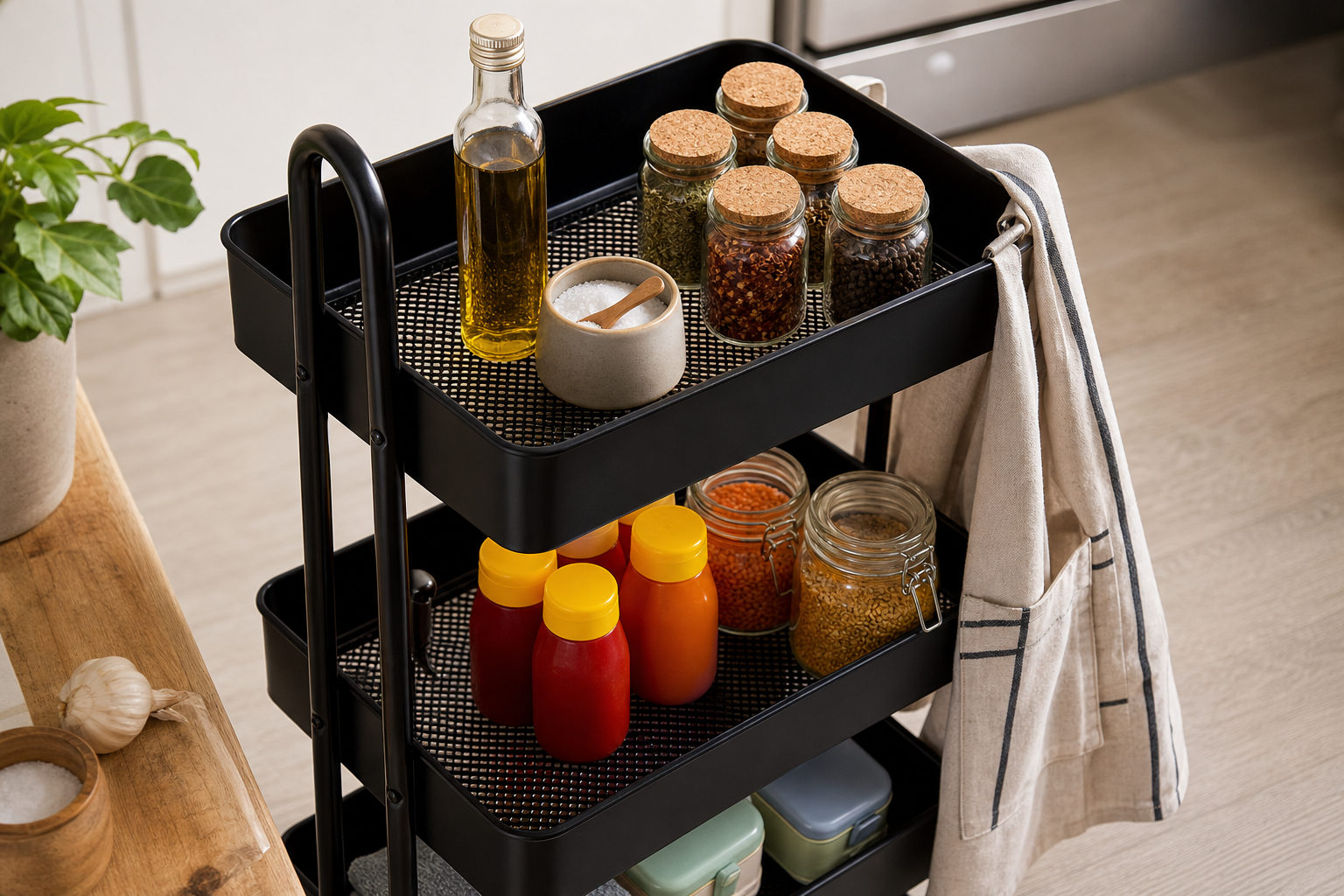
If your kitchen is truly small — a galley layout, an apartment kitchen with almost no counter space — a slim 3-tier rolling cart like the one from USTECH can function as a movable pantry. Load the top tier with daily-use items, the middle with backup pantry stock, and the bottom with heavier bottles and containers. Roll it into a narrow gap beside the fridge or stove when you're not cooking, and pull it out when you need it. The locking wheels mean it stays put once you've positioned it.
Q: The counter is my only real workspace. How do I keep it clear without just moving the clutter somewhere worse?
The counter clutter problem is almost always a placement problem, not a stuff problem. Things pile up on counters because there's no obvious home for them anywhere else. The fix is giving each category a designated spot off the counter before it lands there.
A rolling cart positioned near the stove handles oils, spatulas in a crock, and spice jars — things that would otherwise creep onto the counter because they're used constantly. A small hook rail on the inside of a cabinet door handles measuring spoons, a can opener, and scissors. A single basket on a shelf handles the "miscellaneous kitchen drawer" items that never had a real home.
The rule: if something lives on the counter permanently, it should either be used every single day or be genuinely decorative. Everything else needs a shelf, a drawer, a cart, or a cabinet — even if that means rethinking what's currently occupying those spots.
Q: Is a rolling cart actually sturdy enough to hold heavier kitchen items like jars and bottles?
A well-built metal rolling cart — powder-coated steel, not flimsy plastic — handles the weight of pantry jars, oil bottles, and canned goods without issue. The USTECH 3-Tier Rolling Cart is metal construction, and customers consistently note it's sturdier than it looks in photos. The locking casters are the detail that matters most for heavier loads: once locked, the cart doesn't shift when you're pulling items off the shelves.
The slim profile is the other practical consideration. Most rolling carts in this category are designed to slide into the kind of narrow gaps that exist in small kitchens — beside the refrigerator, between the stove and the wall, or in a tight corner. That's where they earn their keep.
Q: What about the stuff I genuinely have no room for anywhere — not cabinets, not a cart, not the counter?
Be honest about whether you actually need it. Kitchens accumulate duplicate tools, single-use gadgets, and aspirational appliances that never get used. A second colander, three spatulas when one would do, the spiralizer from two years ago — these are cabinet occupiers, not kitchen essentials.
Pare down to what you genuinely cook with, then organize what remains. The goal isn't to find a hiding spot for everything you own. It's to make the things you actually use easy to reach and easy to put back.
If you're working with a kitchen that's genuinely short on storage, a rolling cart is one of the most flexible fixes available — it adds vertical storage, moves when you need it to, and doesn't require a landlord's permission to install. Learn more about how to use open-rack storage to tackle clutter throughout your home — the same logic that works in the kitchen applies to every room that's short on built-in storage.
Explore USTECH's rolling cart and open-rack storage options — practical picks for kitchens where cabinet space is always running short. Visit ustech-usa.com to see the full lineup.
Frequently Asked Questions
Can a rolling cart replace a pantry in a small kitchen?
It can do a lot of the same work. A 3-tier metal rolling cart holds dry goods, oils, jars, and produce — the core of what a pantry stores — and its vertical design means it takes up far less floor space than a freestanding pantry cabinet. It won't hold everything a full pantry would, but for a small apartment kitchen, it's a genuinely practical substitute for dedicated pantry storage.
Where should a rolling cart go in a small kitchen without much floor space?
Look for the narrow gaps that already exist: beside the refrigerator, between the stove and the wall, or in a corner that's currently dead space. Slim-profile rolling carts are specifically designed to fit into these spots. When you need the cart for prep or serving, you roll it out; when you don't, it tucks back in. That flexibility is the whole point.
What's the best way to organize a 3-tier rolling cart in the kitchen?
Use the tiers by frequency and weight. The top tier — easiest to reach — is best for daily-use items like cooking oils, a salt cellar, or a coffee setup. The middle tier works well for pantry staples you use a few times a week. The bottom tier, closest to the floor, handles heavier items: large jars, bottles, or bulkier containers. Keeping heavier items low also makes the cart more stable when you're rolling it.
Are rolling carts a good option for renters who can't install shelves?
They're one of the best options. A rolling cart requires no drilling, no wall anchors, and no landlord approval — you just assemble it and place it where you need it. When you move, it comes with you. For renters dealing with minimal built-in storage, a freestanding rolling cart adds real, usable storage without touching a single wall.


