


The Real Problem With "Just Organize It"
Most decluttering advice assumes you can spend a weekend hauling bins, crouching on the floor, and reassembling shelves. That advice doesn't hold up well when bending down is painful, balance is a concern, or the goal is a system that stays organized on its own — not one that needs weekly resetting.
Decluttering for seniors isn't a lesser version of decluttering. It's a smarter version. The constraints are real: limited reach, joints that protest repetitive motion, and a lifetime's worth of belongings that won't sort themselves. The good news is that a handful of targeted storage swaps — not a whole-house overhaul — can dramatically reduce the daily friction of finding things, putting them away, and moving safely through a space.
This post compares the storage approaches that actually help against the ones that just add steps.
Shoes on the Floor vs. an Open Tiered Rack
Shoes scattered near the door or piled at the bottom of a closet are one of the most common tripping hazards in the home — and one of the easiest to fix. The comparison here isn't complicated.
Floor piles: Every pair requires bending all the way down to retrieve it. Pairs get separated, buried, or kicked under furniture. Finding the right shoe before a doctor's appointment or a walk becomes a small but genuinely frustrating hunt.
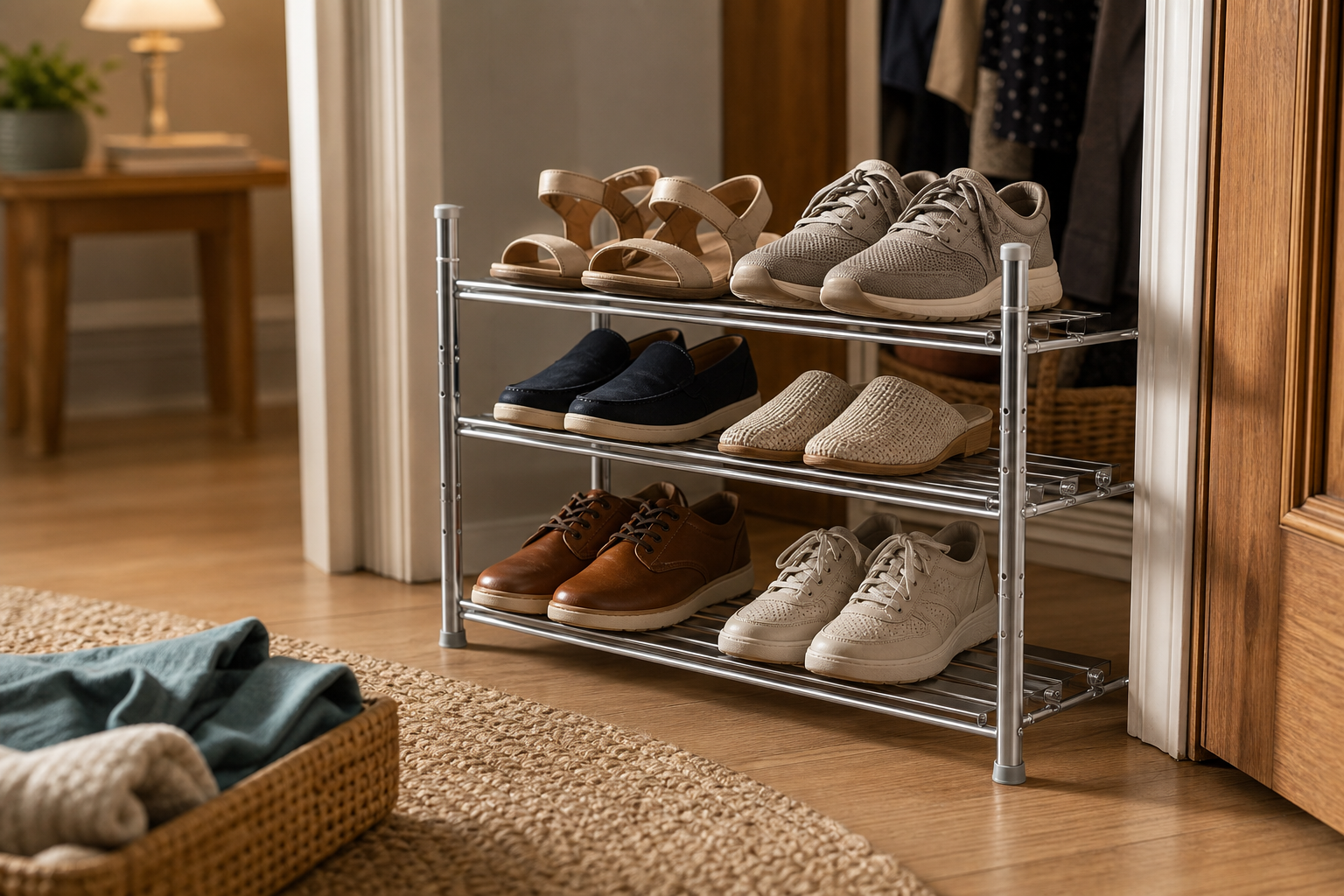
A multi-tier shoe rack: Shoes sit at staggered heights, visible and paired. The top tiers keep frequently worn shoes at a comfortable reach — no crouching required. A rack with adjustable shelf heights (like the slide-and-adjust style) can be configured so the shoes used most often sit right at hip or mid-thigh level, which is the easiest range of motion for most adults.
The other underrated benefit: a rack creates a fixed home for each pair. That predictability matters more than it sounds. When everything has a designated spot, you stop scanning the floor, stop second-guessing, and stop bending unnecessarily.
If closet space is limited, a freestanding rack in the entryway or bedroom corner works just as well — and keeps shoes off the floor where they're a hazard.
Overstuffed Closet Rods vs. Fewer, Better Hangers
Here's a scenario that's more common than people admit: a closet rod so packed that pulling out one shirt means wrestling with five others. The hangers tangle, clothes wrinkle, and the whole thing becomes something to avoid rather than use.
The fix isn't necessarily a bigger closet. It's reducing the number of items on the rod and giving each one a hanger that actually holds it in place.
Thin wire hangers let clothes slide and bunch together. Shoulders slip off, pants fold awkwardly, and the rod ends up looking chaotic even with just a moderate number of items on it.
Shaped hangers with shoulder notches and a pant bar keep each garment in its own lane. A shoulder notch stops straps and necklines from sliding off. A built-in pant bar means trousers hang folded and ready — no separate clip hanger needed. Non-slip coating keeps lightweight fabrics from drifting. The result is a rod where you can actually see and reach each item without tugging at its neighbors.
For seniors specifically, the ergonomic payoff is real: when hangers hold clothes securely and items aren't jammed together, you're pulling with one clean motion instead of a prolonged tug-of-war. That's easier on wrists, shoulders, and balance.
A wood-look hanger also adds a visual calmness to a closet that wire and plastic don't. It sounds minor, but a visually organized closet is one you're more likely to maintain — and less likely to dread opening.
The "Everything in Boxes" Trap
Bins and boxes feel organized. They're often not — at least not for daily use. When frequently needed items (medications, reading glasses, a favorite cardigan) are stored in lidded containers, every retrieval involves lifting a lid, digging through contents, and replacing the lid. Multiply that across a day and it adds up to a lot of unnecessary motion.
The better approach for everyday items: open storage at the right height. Hooks, open racks, and visible shelving mean you can see and grab what you need in one movement. Reserve lidded storage for things you access rarely — seasonal items, keepsakes, documents.
This isn't about aesthetics. It's about reducing the number of physical steps between you and the things you use every day.
Guest Rooms and Spare Spaces: The Luggage Problem
If you host family — adult children, grandchildren, caregivers who stay over — a folding luggage rack in the guest room solves a specific problem that rarely gets discussed: where does a visitor's open suitcase go?
Without a rack, bags end up on the bed (taking up sleeping space), on the floor (a tripping hazard), or half-unpacked on a chair. A folding rack gives visitors a designated surface at a standing height, keeps the floor clear, and folds flat when the room isn't in use.
For the senior homeowner, that cleared floor matters. A guest room that doubles as a walking path to a bathroom shouldn't have bags on the floor at 2 a.m.
What to Actually Prioritize First
If a full-home overhaul feels overwhelming — and it should, because it is — start with the spaces where you move most often and where clutter creates the most physical risk.
- The entryway or bedroom floor — shoes off the floor, onto a rack. This is the highest-impact, lowest-effort swap.
- The main closet rod — thin out the hangers, replace wire with shaped ones that hold garments in place. You don't need to replace every hanger at once; start with the section you use daily.
- The guest room floor — a folding luggage rack eliminates a recurring obstacle without taking up permanent space.
None of these require tools, heavy lifting, or a contractor. They're swaps, not renovations. And unlike a big reorganization project, they stay organized because the system itself does the work — not your ongoing effort to maintain it.
For more on building a clutter-free home with minimal ongoing effort, this guide covers the fundamentals in depth.
The goal isn't a magazine-perfect home. It's a home where you move through your day without unnecessary obstacles — and that's entirely achievable with a few well-chosen swaps. Browse USTECH's adjustable shoe racks and shaped hangers — both assemble without tools and reconfigure as your needs change.
Frequently Asked Questions
What's the safest way to organize shoes for seniors who have balance concerns?
A freestanding tiered shoe rack is one of the safest options because it keeps shoes off the floor entirely, eliminating a common tripping hazard. Look for a rack with adjustable shelf heights so the most-used pairs sit at hip or mid-thigh level — that's the range where you can reach without bending low or stretching up, which reduces the risk of losing your balance.
How do I declutter a closet without it being a physically exhausting project?
Break it into one section at a time — just the shoe area one day, just the hanging rod another. You don't need to do it all at once. The biggest gains come from two simple changes: getting shoes off the floor onto a rack, and replacing tangled wire hangers with shaped ones that hold garments in place. Those two swaps alone make a closet significantly easier to use day-to-day.
Are folding luggage racks hard to set up or put away?
Most folding luggage racks are designed to open and fold flat without tools — it's a straightforward fold-out motion. When not in use, they store flat under a bed or in a closet without taking up much space. They're one of the easier pieces of guest-room furniture to manage on your own.
Is open storage or closed storage better for everyday items?
For things you reach for daily — shoes, frequently worn clothes, everyday accessories — open storage wins. It lets you see and grab what you need in one motion, with no lid to lift or bin to dig through. Closed storage (bins, boxes) is better reserved for items you access rarely, like seasonal clothing or keepsakes, where the extra step of opening a container doesn't slow you down.


