


The Method Isn't the Problem — the Follow-Through Is
Most people who've tried to declutter have also tried at least one named method. They've held items and asked whether it sparks joy, or they've stood in their entryway calculating whether they could replace something for under twenty dollars. And then, six weeks later, the pile is back.
The method rarely fails in the sorting phase. It fails in the setup phase — when there's nothing waiting to hold what you decided to keep. Clothes end up draped over a chair. Shoes drift back to the floor. The entryway looks the same by Thursday.
This post compares three popular decluttering approaches — KonMari, the 20/20 rule, and box-and-donate — and maps each one to the specific area of the home where it actually performs well: the closet, the entryway, and the shoe situation. Then it gets into which physical tools make the results stick.
KonMari: Best for the Closet
The KonMari method, developed by Marie Kondo, works by category rather than room. You pull every item in a category (say, all clothing) into one place, handle each piece, and keep only what genuinely earns its spot. It's thorough in a way that most people find uncomfortable — which is exactly why it works for closets.
Closets accumulate slowly and invisibly. Shirts get pushed to the back. Pants you haven't worn in two years still take up a full foot of rod space. KonMari forces a full accounting, and that's the right approach when the problem is volume.
Where it breaks down: after the sort, you need a closet system that actually handles what's left. If you're keeping dress shirts, casual tops, and trousers — each needing different hang lengths and spacing — a mix of standard and specialty hangers matters more than most people expect. Uniform hangers (especially ones with shoulder notches and non-slip features) let you compress space meaningfully and keep the visual calm that the method promises.
KonMari also introduced vertical folding for drawers, but for hanging items, the rod is still doing the heavy lifting. The method creates the edit; the hangers hold the result.
The 20/20 Rule: Best for the Entryway
The 20/20 rule comes from minimalist writers Joshua Fields Millburn and Ryan Nicodemus. The idea: if you can replace something for under $20 in under 20 minutes, you don't need to keep it out of fear. Let it go.
It's a decision shortcut, not a full system — and that makes it well-suited to entryways, where the clutter is usually functional gear: umbrellas, reusable bags, dog leashes, spare keys, jackets that "might be needed." The emotional weight is low, the replacement logic is easy to apply, and the category is small enough that you can work through it in an afternoon.
What the 20/20 rule doesn't tell you is what to do with the things that stay. An entryway that's been edited still needs a place for everyday coats, a spot for bags, and — critically — a luggage rack or dedicated shelf for the bags people actually use week to week. Without that structure, cleared space fills back up within days.
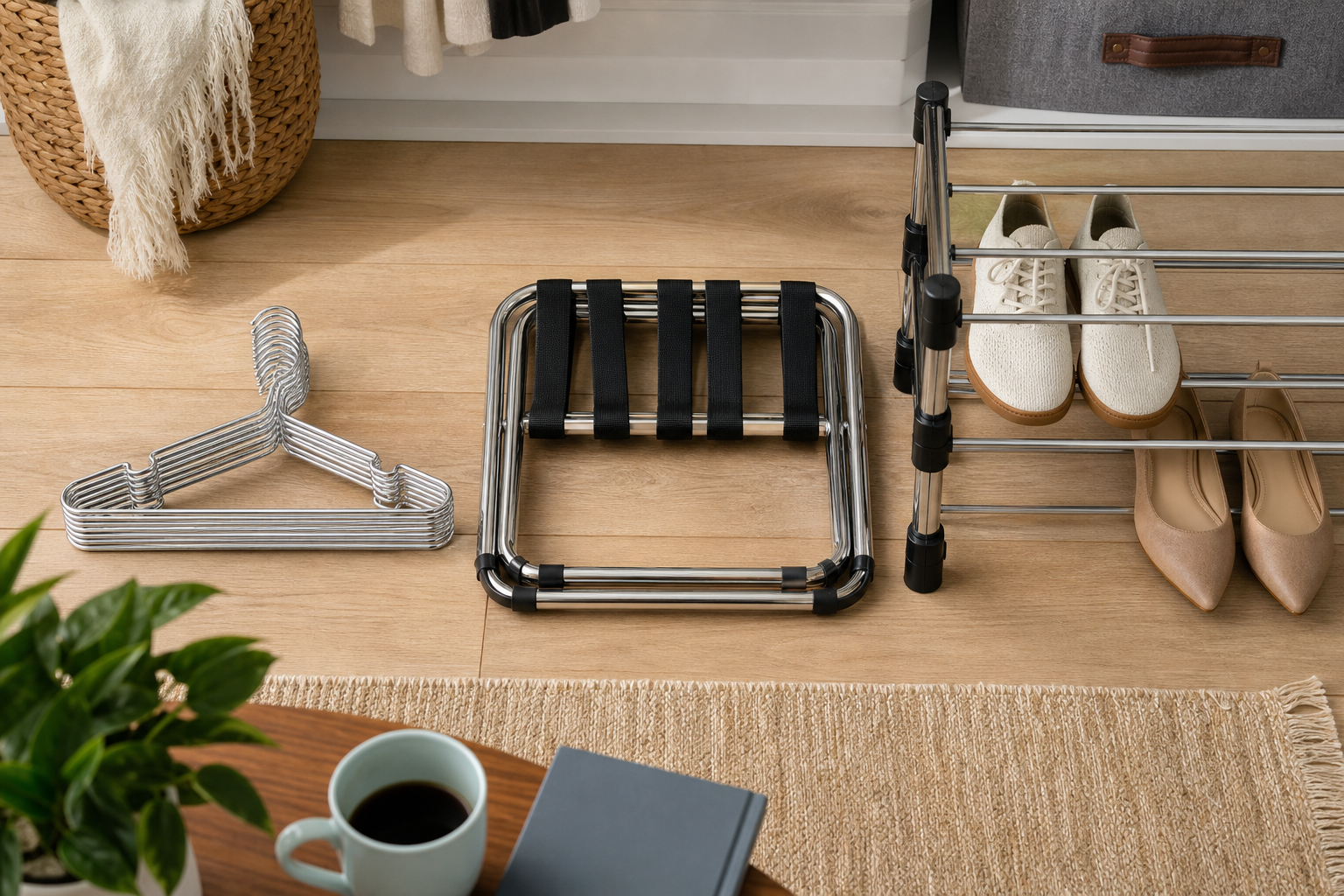
A folding luggage rack in the entryway or just inside a coat closet gives travel bags a fixed home, which stops them from landing on the floor or the nearest chair every time someone comes through the door.
Box-and-Donate: Best for Shoes
Box-and-donate is the least structured of the three. You grab a box, fill it with things you're not using, and get it out of the house before you second-guess yourself. No framework, no categories, no rules about what sparks what.
For shoes, this is often the right call. Shoe decisions are rarely philosophical — you know which pairs you wear and which ones have been sitting untouched since last winter. The box-and-donate approach works here because it lowers the activation energy. You don't need a system; you need a box and a deadline.
The problem shoes present isn't usually the decision — it's the storage after. Even a well-edited shoe collection turns chaotic without a proper rack. Pairs get separated, heels scuff flats, boots tip over. A tiered shoe rack with adjustable shelves solves this immediately and makes the effort of the edit visible every time you walk past it.
Adjustable racks matter specifically for shoes because the mix is almost always uneven: low flats, mid-height sneakers, tall boots. A fixed-height rack wastes space or can't accommodate the taller pairs at all.
A Quick Comparison
| Method | Best Area | Strength | Limitation | Tool That Makes It Stick |
|---|---|---|---|---|
| KonMari | Closet | Forces a full category audit | Doesn't address storage setup | Uniform hangers with shoulder notches and non-slip features |
| 20/20 Rule | Entryway | Fast, low-friction decisions | No system for what stays | Folding luggage rack or coat/bag hooks |
| Box-and-Donate | Shoes | Low barrier, quick execution | Chaos returns without structure | Adjustable multi-tier shoe rack |
Why the Storage Tool Is the Last Step, Not an Afterthought
Every decluttering method assumes you'll figure out the storage part on your own. Most people don't — or they buy something generic that doesn't fit the space or the category, and the system quietly collapses.
The tools that hold a decluttered space together have a few things in common: they're sized for the actual items (not just "clothes" or "shoes" in the abstract), they're easy to use daily without any extra effort, and they make the organized state the path of least resistance. That last part is the one most people skip.
A non-slip hanger means a shirt doesn't end up on the floor after you brush past it. An adjustable shoe rack means every pair has a slot that fits. A folding luggage rack means a bag has a home that isn't the bedroom floor. None of these are dramatic — but they're the difference between a declutter that lasts a month and one that lasts.
If you want to go deeper on the tools side, this guide to clutter-free home tools covers the specifics in more detail.
Pick One Area, Not the Whole House
The biggest mistake people make with decluttering isn't choosing the wrong method — it's trying to do the whole house at once. That's how you end up with three half-finished piles and nothing resolved.
Start with the area that bothers you most. If it's the closet, use KonMari and get the right hangers before you start. If it's the entryway, run the 20/20 rule on everything in it and then give the keepers a real home. If it's shoes, grab a box, edit hard, and order a rack before the edit is done so there's something to put the remaining pairs on.
The method gets you to a decision. The storage makes the decision permanent.
Ready to set up the storage your decluttered space actually needs? Browse USTECH's shoe racks, hangers, and luggage racks — built specifically for closets, entryways, and everything in between.
Frequently Asked Questions
Do I need to follow one decluttering method strictly, or can I mix them?
Mixing is fine — and often smarter. The methods described here are decision frameworks, not rules. Using KonMari's category-by-category approach for clothes while applying box-and-donate logic to shoes is a perfectly reasonable way to work. The goal is getting to a decision, not following a specific script.
How do I keep a decluttered closet from getting cluttered again?
The most reliable fix is making the organized state easier than the disorganized one. That means every item has a specific place — not just a general zone — and the storage tools make it effortless to return things there. Uniform hangers with non-slip features, for example, make it faster to hang a shirt than to drape it somewhere. Friction works in your favor when the storage is right.
What type of shoe rack works best for a mixed collection of flats, sneakers, and boots?
An adjustable multi-tier rack is the most practical choice for a mixed collection. Fixed-height shelves either waste space on low pairs or can't fit taller boots at all. Adjustable shelving lets you configure each tier to the actual height of the shoes going on it, which means more pairs fit and nothing gets damaged by being forced into the wrong slot.
Is a luggage rack worth it if I only travel a few times a year?
Yes — arguably more so. Frequent travelers tend to develop habits around where bags live. Occasional travelers are the ones who leave a suitcase on the bedroom floor for two weeks after a trip because there's no obvious home for it. A folding luggage rack solves that by giving the bag a fixed spot that's out of the way but accessible, and it folds flat when not in use so it doesn't take up permanent space.


