


The Real Cost of "Cheap" Closet Organization
Here's the trap most people fall into: they spend a Saturday afternoon on Pinterest, buy three different tension rods, a bag of shower curtain rings, and a set of cardboard drawer dividers — and feel genuinely proud of themselves for spending under $20. Then, four months later, the tension rod has slipped twice, the cardboard is warped from humidity, and the shower curtain rings have stretched out two sweater necks. So they do it again.
That $20 "budget" solution has now cost $60 and a lot of frustration. The smarter question was never how little can I spend? It was what's the actual cost per use?
The DIY Hacks Worth Keeping (and the Ones to Skip)
Not every low-cost trick is a waste. Some genuinely solve real problems without creating new ones. Others look great in a flat-lay photo and fall apart in the real world.
Actually useful
- Velvet hangers for delicates. Thin, non-slip, and they do keep clothes from sliding. The downside: they compress easily and don't hold structured pieces like blazers or coats well. Use them selectively.
- Over-the-door hooks for bags and accessories. A simple hook rail on the back of a closet door adds real storage without touching a single shelf.
- Shelf dividers for folded stacks. If your shelves are fixed and you're dealing with toppling sweater piles, a simple divider clip does the job.
Instagram bait — skip it
- Shower curtain rings as scarf/belt organizers. They work for about a week before they start catching on fabric and scratching delicate materials. Purpose-built accessory hangers exist for a reason.
- Cardboard box dividers in drawers. Humidity warps them. They shift around. They're not holding anything in place after the first real rummage.
- Tension rods as shelf dividers. Fine for a light load in a stable environment. Add a few heavier items or a door slam and they're on the floor.
- Stacked shoeboxes. You will stop opening the bottom ones within two weeks. Guaranteed.
Where Purpose-Built Hardware Actually Wins
The gap between a DIY hack and a purpose-built product isn't always price — it's engineering. A well-made hanger is shaped to hold a garment's weight at the right points. A multi-tier shoe rack is designed so you can actually see and reach every pair. These aren't luxury features; they're just things that work the way you expect them to.
Take hangers as an example. A bowed hanger with a shoulder notch and a pant bar isn't a premium upgrade — it's a functional tool that keeps a blazer's shape intact and holds trousers without a clip that leaves a crease. That's worth more than a dozen wire hangers that bend and tangle every time you pull one out.
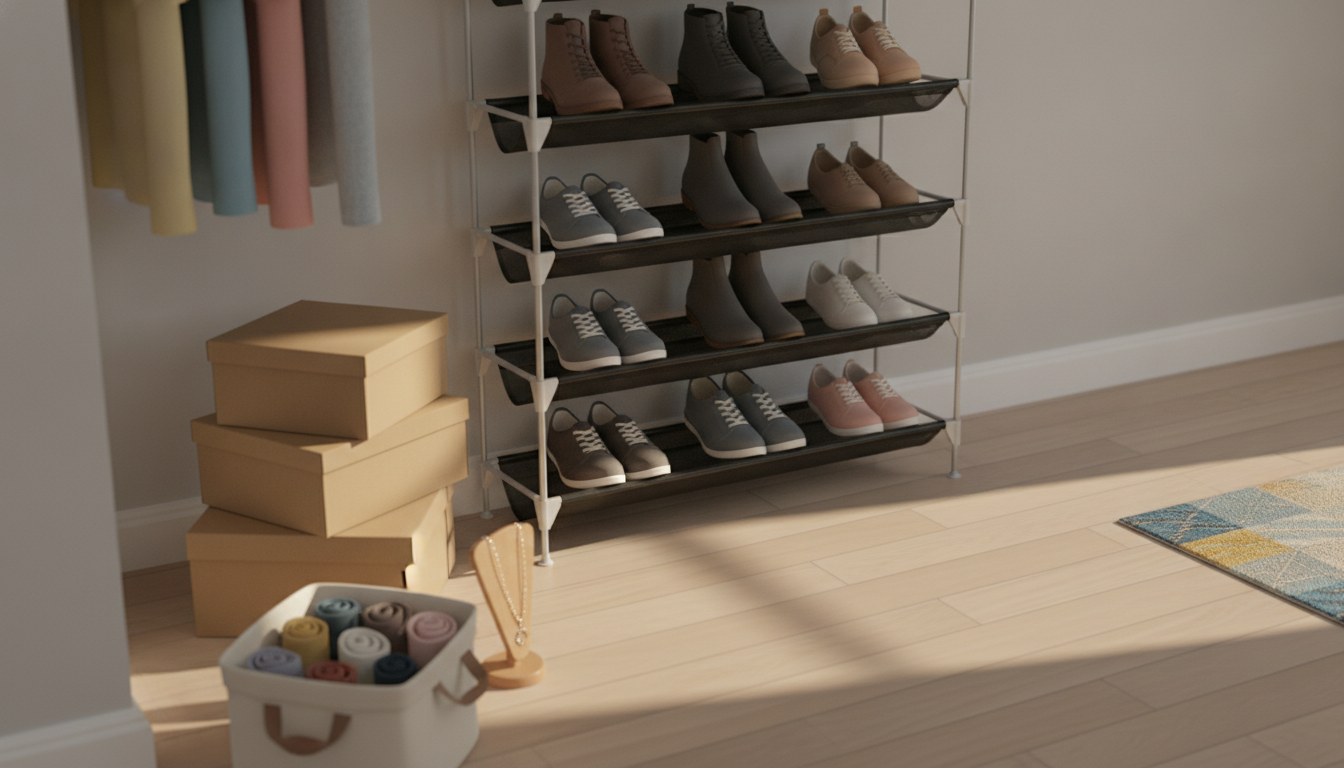
Shoe storage is where the stacked-boxes habit really costs people. A 5-tier adjustable shoe rack lets you see every pair at a glance and adjust the shelf spacing as your collection changes. Compare that to digging through boxes on the floor every morning — the rack pays for itself in time alone.
A Side-by-Side: DIY vs. Purpose-Built
| Problem | DIY Hack | Reality Check | Purpose-Built Alternative |
|---|---|---|---|
| Clothes slipping off hangers | Rubber bands on hanger ends | Falls off, leaves marks on fabric | Non-slip coated hangers with shoulder notches |
| Shoes piling up on the floor | Stacked shoeboxes | You stop using the bottom ones immediately | Multi-tier adjustable shoe rack |
| Pants sliding or creasing | Folding over a wire hanger | Crease marks, tangled hangers | Hanger with a built-in pant bar |
| Luggage taking up floor space | Stacking bags in a corner | Bags get crushed, hard to access | Folding luggage rack with nylon straps |
The $30–$60 Rule That Actually Makes Sense
Most closets have three or four real problem areas: hangers that don't work, shoes on the floor, folded clothes that topple, and luggage that takes up too much room. Solving each one with a purpose-built product — not the premium version, just the right one — typically lands in the $30–$60 range per category. That's a one-time spend that lasts years.
Contrast that with buying a $10 tension rod, replacing it, trying a different hack, buying another set of rings — and you've spent the same money with nothing to show for it except a messier closet and a junk drawer full of failed experiments.
The budget mindset that actually works isn't about spending as little as possible upfront. It's about not spending twice.
If you want to go deeper on how the right hardware transforms a cluttered space, this guide to clutter-free home tools is worth a read before you buy anything.
Where to Start If Your Closet Is a Disaster Right Now
Don't try to fix everything at once. Pick the single most annoying thing about your closet — probably the floor situation or the hanger chaos — and solve just that first. A 5-tier shoe rack or a set of properly shaped hangers will make an immediate, visible difference. Once that's done, the next problem becomes obvious.
Organization isn't a one-weekend project. It's a series of small, permanent fixes that compound over time. Start with one that actually holds.
Browse USTECH's full lineup of closet organization hardware — built to last longer than the next reorganization urge.
Frequently Asked Questions
Are adjustable shoe racks actually stable, or do they tip over when loaded?
A well-engineered shoe rack with rubber feet and a sturdy steel frame stays put under normal use. The key is choosing one rated for the number of pairs you actually own — overloading a lightweight rack is where tipping becomes an issue. Look for racks with a wide base and non-slip feet, and distribute weight evenly across tiers.
What's the difference between standard hangers and bowed hangers — does it actually matter?
It matters for structured garments. A bowed hanger follows the natural curve of a shoulder, which helps blazers, jackets, and dress shirts hold their shape instead of developing a pinched crease at the top. For T-shirts and casual wear, the difference is minimal. For anything you'd wear to work or an occasion, it's worth it.
How many hangers do I actually need to buy to make a noticeable difference?
Replacing all your hangers at once with a consistent style makes the biggest visual impact — mixed hanger types create visual noise even when clothes are organized. Count what's currently hanging in your closet and replace in one go. It's one of the cheapest, highest-impact closet upgrades you can make.
Is a luggage rack worth it if I only travel a few times a year?
If your luggage currently lives on the floor or stacked in a corner, yes. A folding luggage rack stores flat when not in use, so it takes up almost no space. When guests visit, it doubles as a suitcase stand in the guest room — which is genuinely useful even if you're not the one traveling.


