


The reorganization that doesn't stick
You spend a Saturday pulling everything out, sorting, folding, and putting it all back in a way that finally makes sense. It looks great. You feel great. Then three weeks later you open the closet door and it's somehow worse than before.
This isn't a discipline problem. It's a design problem. Most closets fail not because their owners are disorganized, but because the tools inside them weren't built to hold order. The wrong hanger slips. Shoes pile up because there's nowhere logical to put them. A suitcase gets shoved on the floor and becomes a shelf for everything else. Chaos follows a predictable pattern — and once you see it, it's fixable.
Wrong hangers are doing more damage than you think
Thin wire hangers let clothes slide off. Mismatched plastic ones take up inconsistent space and make the rod look chaotic even when clothes are technically hung. And when garments slip or bunch, people stop hanging them properly — they drape, they pile, they give up.
A uniform hanger with shoulder notches and a non-slip coating keeps each piece exactly where you put it. A pant bar on the same hanger means trousers don't need their own separate hooks or a folded-over compromise. When every item in your closet hangs the same way and stays put, the rod stays readable at a glance — and readable spaces stay organized because putting things back takes no effort.
It sounds small. It isn't. Hanger consistency is the single cheapest structural fix in a closet, and it's usually the last thing people address.
Shoes with no home will always end up on the floor
Shoes are the fastest closet-killer. One pair left on the floor becomes a landing zone. A second pair joins it. Within a week you have a pile that makes the whole room feel cluttered even if the rest of the closet is tidy.
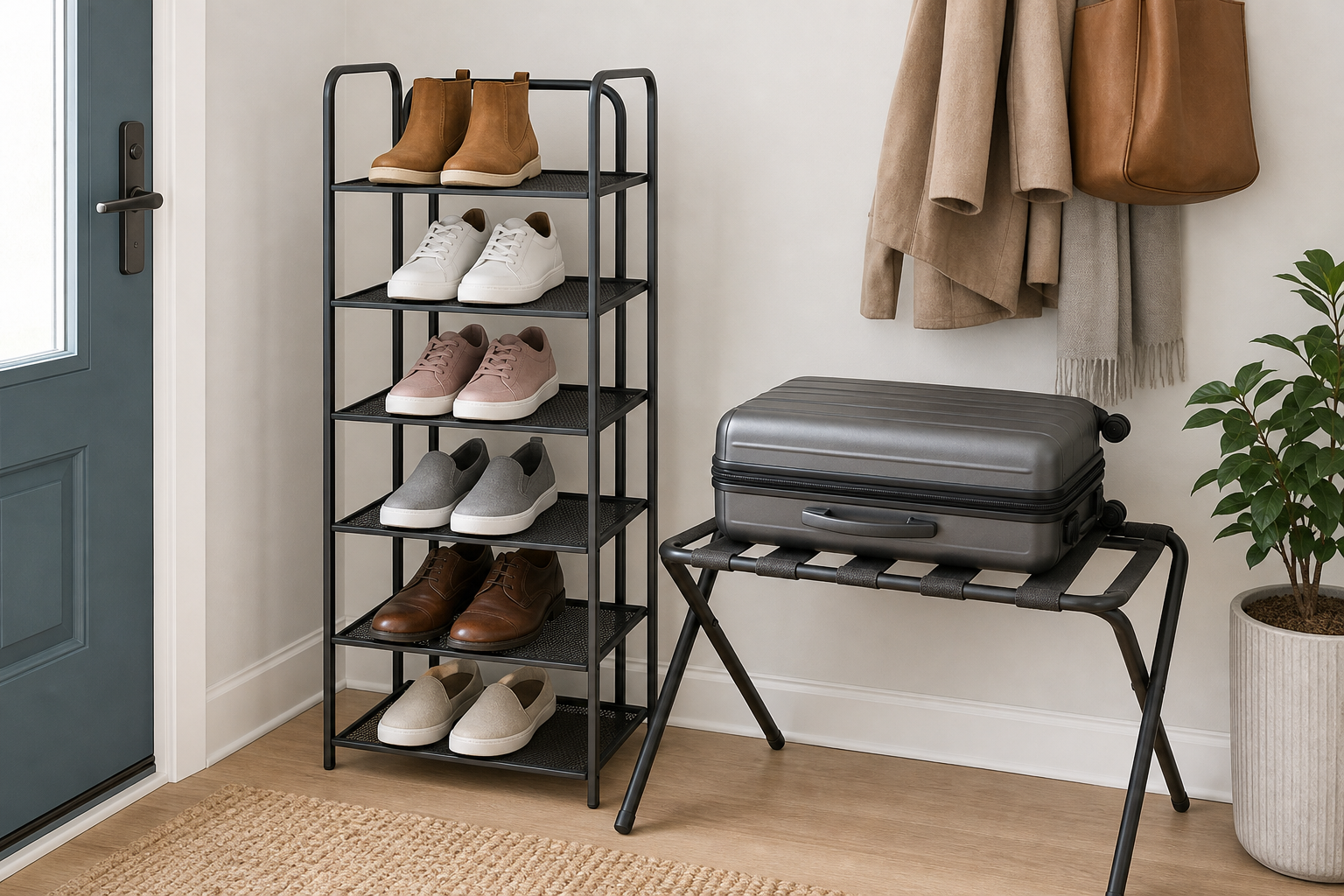
The fix isn't telling yourself to put shoes away more diligently — it's giving every pair a specific, visible slot. A tiered shoe rack turns a chaotic floor situation into a system. Adjustable-height tiers matter here more than people expect: boots, flats, and sneakers all have different profiles, and a rack that can't accommodate them forces compromise, which means some pairs end up on the floor anyway.
If floor space is limited, look for a rack with a slim footprint and multiple tiers — you're trading horizontal spread for vertical height, which most closets and entryways have to spare.
The suitcase problem nobody talks about
A suitcase parked on the closet floor is a magnet. It's a flat surface at a convenient height, so things land on top of it — gym bags, belts, items that didn't get a proper home. Before long it's buried, and getting to it means moving everything that accumulated on and around it.
A dedicated luggage rack solves this in two ways. First, it gets the bag off the floor and onto a frame, which eliminates the flat-surface effect. Second, it signals that the bag has a place — which makes it easier to return it there after a trip rather than dropping it wherever.
In a guest room, a luggage rack also means guests aren't living out of a bag on the floor for the duration of their stay, which is a small but real upgrade in how a room functions. A well-built rack with rubber feet and nylon straps keeps the bag stable without scratching floors or walls.
The real reason re-cluttering is so fast
When organization requires active decision-making every time you put something away, it degrades. You're tired, you're in a hurry, and the "right" spot isn't obvious — so the item lands somewhere approximate. Multiply that by every person in the household, every day, and the closet reverts in weeks.
Good storage hardware removes the decision. A shoe rack with defined slots makes the right place obvious. Uniform hangers make hanging a shirt faster than folding it. A luggage rack makes returning the suitcase easier than leaving it on the floor. The system maintains itself not because you're more disciplined, but because the path of least resistance is now the organized path.
That's the actual goal: not a closet that looks good in photos, but one that's easy to maintain on a Tuesday evening when you don't have the energy to think about it.
Where to start if your closet is already a mess
Don't try to fix everything at once. Pick the single biggest source of chaos — usually shoes or hangers — and address that first. Get the floor clear, get a consistent hanger system on the rod, and let the closet breathe for a week. You'll quickly see what the next problem is.
Most closets need three things: a uniform hanging system, a tiered shoe solution, and a place for bags and luggage that isn't the floor. Address those three in order and you've covered the root causes of probably 80% of closet re-clutter.
For a deeper look at building a clutter-free home from the ground up, this guide covers the full picture — worth reading before you buy anything.
Ready to stop reorganizing the same closet every few months? Explore USTECH's closet organization solutions — hangers, shoe racks, and luggage racks built to hold order, not just create it.
Frequently Asked Questions
How many hangers do I actually need to make a difference?
Enough to replace every mismatched one on the rod — partial upgrades don't work. A mix of old wire and new uniform hangers still looks chaotic and still lets items slip. The consistency of the whole rod is what makes the difference, so commit to replacing them all at once rather than gradually.
What's the best shoe rack for a small closet with limited floor space?
Look for a multi-tier design with a narrow footprint — you want height over width. Adjustable tiers are a real advantage if you're storing a mix of boot heights and flat shoes, since a fixed-height rack will leave wasted space or force pairs to hang over the edge. Measure your floor space before buying and prioritize vertical capacity.
Do I need a luggage rack if I only travel a few times a year?
Probably yes — because infrequent travelers are actually more likely to leave a suitcase parked on the floor for weeks after a trip. A rack gives the bag a defined spot, which makes it easier to store properly and easier to retrieve when you need it. Between trips it also keeps the bag off the floor, which protects both the bag and your flooring.
Why does my closet get messy faster than the rest of my home?
Closets are high-frequency, low-attention spaces. You open them quickly, grab what you need, and close the door — so small disorganizations compound fast without being noticed until they're overwhelming. The other reason is that most closets lack defined zones, so items default to wherever they fit rather than wherever they belong. Defined storage (a rack for shoes, a rack for luggage, a consistent hanger system) creates zones that make the right choice the fast choice.


